
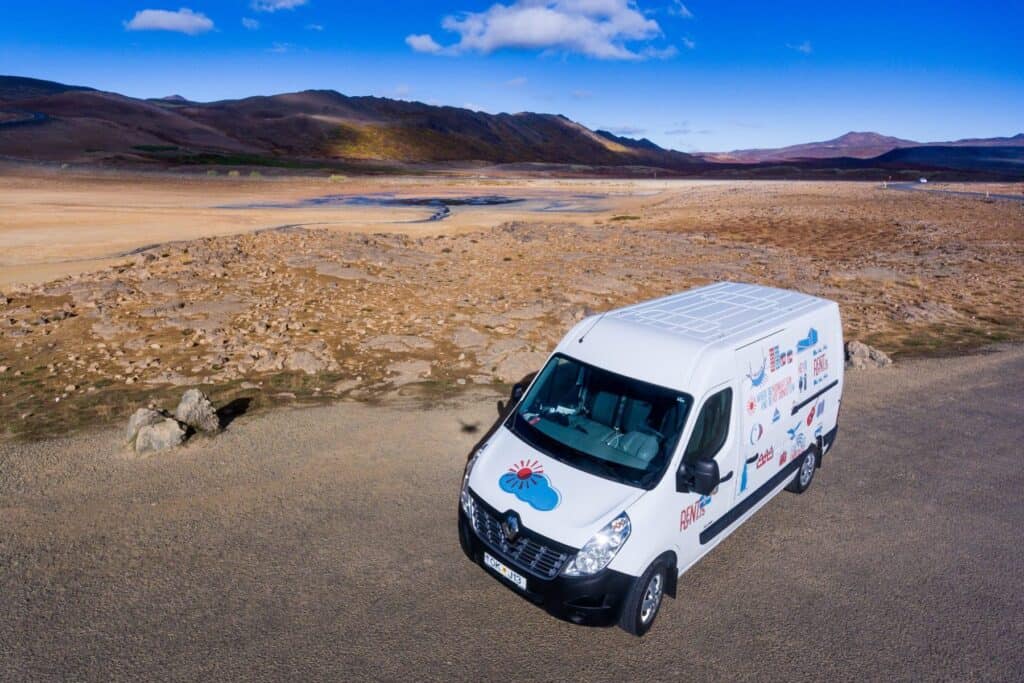
Iceland has a way of making you feel small. In a single day on the Golden Circle, you’ll stand in a rift between two continents, watch the earth surge boiling water fifty feet into the air, and stare into a waterfall so powerful the ground shakes beneath your feet. All of it within a few hours of Reykjavík.
The Golden Circle is Iceland’s most famous driving route and one of the most popular things to do in Iceland – and for good reason. This guide covers everything you need to plan it: the route, the stops, how long it takes, whether a camper van makes sense, and what most visitors miss.
What is the Golden Circle in Iceland?
The Golden Circle is Iceland’s most iconic self-drive route. A 230–300 km (140-186 mile) loop through the southwest that begins and ends in Reykjavík. It connects three of the country’s most celebrated natural and historical landmarks: Þingvellir National Park, Geysir Geothermal Area, and Gullfoss Waterfall.
What makes it special isn’t just the destinations. It’s the variety packed into a single day: you walk the rift valley between two tectonic plates in the morning, watch a geyser erupt every few minutes before lunch, and stand at the edge of a two-tiered glacial waterfall in the afternoon. For a first-time visitor to Iceland, nothing else delivers that range so efficiently.
The route also passes several lesser-known but genuinely rewarding stops—like Kerið crater and Faxafoss waterfall—that make the journey just as memorable as the destinations.
Planning to self-drive the Golden Circle? Check camper van availability for your dates.
Golden Circle at a Glance
| Detail | Information |
| Total distance | 230–300 km (140–186 miles), depending on route and detours |
| Drive time (no stops) | Approx. 3–4 hours |
| Recommended time | 6–8 hours (full day) |
| Start/end point | Reykjavík |
| 3 main stops | Þingvellir, Geysir/Strokkur, Gullfoss |
| Road type | Paved throughout; no F-roads required |
| 4×4 required? | No, not in normal conditions on the standard route |
| Best season | Year-round; winter requires extra care |
Golden Circle Iceland Map & Self-Drive Route
The route is typically driven as a clockwise or counterclockwise loop from Reykjavík. Most travelers prefer the counterclockwise direction — heading south on the Ring Road (Route 1), then east on Route 35 — which means you hit Kerið first and build toward the bigger stops.
Counterclockwise Route Order (Recommended + Additional Stops)
Stop 1 — Kerið Crater Lake: 55 km (34 miles) from Reykjavík via Route 1, then Route 35. You’ll be driving for around 45 minutes on the Ring Road, then you’ll need to turn left onto Route 35 and drive 13 km (8 miles) to reach Kerið on your left.
Stop 2 — Faxafoss Waterfall: Continue 36 km (22 miles) northeast on Route 35. Faxafoss appears on your right, about 21 km (13 miles) before Gullfoss. This additional stop is far less crowded than the main stops, a good place to enjoy some lunch before hitting the road once again.
Stop 3 — Gullfoss Waterfall: Drive 21 km (13 miles) further on Route 35, and you’ll reach one of the most dramatic waterfalls in Europe, dropping 32 meters across two tiers.
Stop 4 — Geysir Geothermal Area (Strokkur): Travel 9.7 km (6 miles) west of Gullfoss on Route 35, and you’ll arrive at the home of the Strokkur geyser, which erupts every 6–10 minutes.
Stop 5 — Laugarvatn: The next part of your journey covers 29.5 km (18 miles) west of Gullfoss on Route 35. Here you can enjoy the geothermal pool, hot spring bath, and the Fontana Spa.
Stop 6 — Þingvellir National Park: For the final stop on your Golden Circle itinerary, you’ll drive another 31.7 km (20 miles) from Laugarvatn on Route 365 / Route 36. The UNESCO World Heritage Site and meeting point of the North American and Eurasian tectonic plates is a fantastic place to end your day of sightseeing.
Return to Reykjavík: When you’re ready to head back to the city, you’ll need to drive 45 km (28 miles) southwest on Route 36. Or, if the weather is good and you’ve time left to explore, take the scenic route back to the Ring Road via Route 360 and Route 435 for more dramatic Highland scenery.
Tip: Check road and weather conditions before you leave Reykjavík, especially in winter. Iceland’s weather changes quickly.
Is the Golden Circle Worth It?
The short answer: yes, especially for first-time visitors.
Here’s a quick decision guide based on your trip type:
| Traveler Type | Worth Doing? | Why |
| First-time Iceland visitor | Absolutely | Best single-day introduction to Iceland’s geology and history |
| Short trip (2–4 days) | Yes | Covers the most ground in the least time |
| Reykjavík day trip | Yes | Easy loop with no overnight stay required |
| Family with kids | Yes | Geysir eruptions and crater walks are crowd-pleasers |
| Ring Road travelers | Yes | Golden Circle sits entirely off the Ring Road; it’s a worthwhile detour |
| Returning visitors | Selectively | Focus on Silfra diving, detours, and lesser-known stops |
| Budget-focused travelers | Yes | Most stops are free or low-cost; fuel is the main expense |
The Golden Circle consistently ranks as Iceland’s most-visited driving route for good reason. Þingvellir alone — the site of the world’s oldest parliament and a visible rift between two continents — is unlike anywhere else on earth.
How Long Does the Golden Circle Take?
Most travelers complete the Golden Circle in 7-9 hours. That’s the full loop with time at the main three stops, but without extended detours.
Here’s a rough time breakdown:
| Segment | TIme |
| Reykjavík to Kerið | ~45 min to an hour drive |
| Kerið | ~30-45 mins |
| Kerið to Faxafoss | ~30 min drive |
| Faxafoss | ~20-30 mins |
| Faxafoss to Gullfoss | ~25 min drive |
| Gullfoss | ~45-60 mins |
| Gullfoss to Geysir/Strokkur | ~15 min drive |
| Geysir/Strokkur | ~45-60 mins |
| Geysir to Laugarvatn | ~30 min drive |
| Laugarvatn (optional swim) | ~60-90 mins |
| Laugarvatn to Þingvellir | ~30 min drive |
| Þingvellir | ~60-90 mins |
| Þingvellir to Reykjavík | ~45 min drive |
Total: approximately 7–9 hours with all stops.
If you’re skipping Laugarvatn and moving quickly, you can complete the three main stops in around 6 hours. Add an overnight stay near Þingvellir or Geysir, and you can explore far more at your own pace — something that’s much easier with a camper van.
Best Stops on the Golden Circle in Iceland
Now that you know what the Golden Circle is and the major attractions it connects, let’s take a closer look at some of the best stops along the route. Whether you drive clockwise or counterclockwise, the following highlights offer breathtaking scenery and a taste of Iceland’s natural wonders.
Kerið
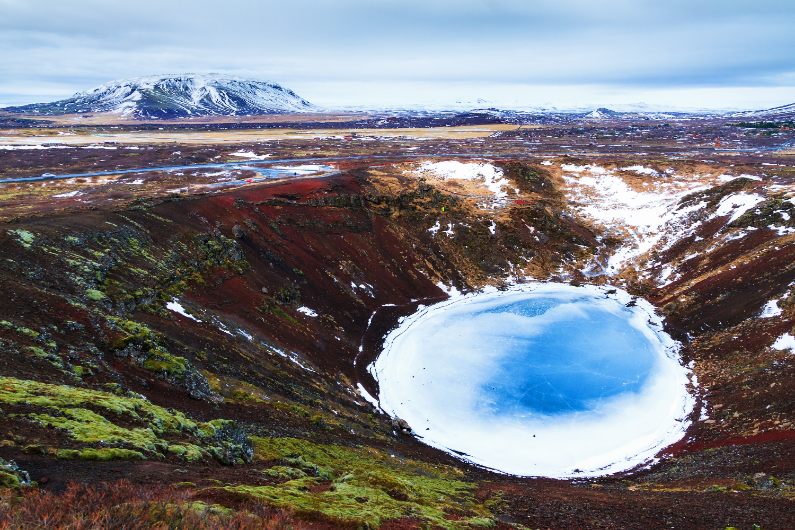
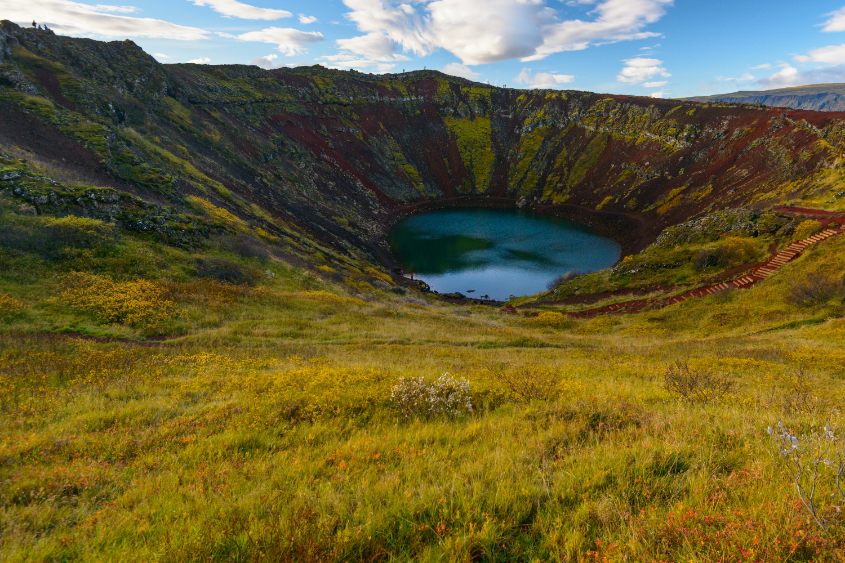
Kerið is a 6,500-year-old volcanic crater with vivid red and black volcanic rock walls that contrast with a still, blue-green lake at the bottom. It’s one of the most photogenic stops on the Golden Circle and is often quieter than the main three attractions.
A small service fee of 700 ISK ($5.70) applies, which covers your admission, parking, and restroom facilities. You can walk the full rim (about 15 minutes) and descend to the lakeside on the west side of the crater. The colors are most dramatic in summer, but the snow-dusted crater walls in winter have their own appeal.
For more detail, see our dedicated guide to Kerið crater lake.
Faxafoss (Faxi Waterfall)
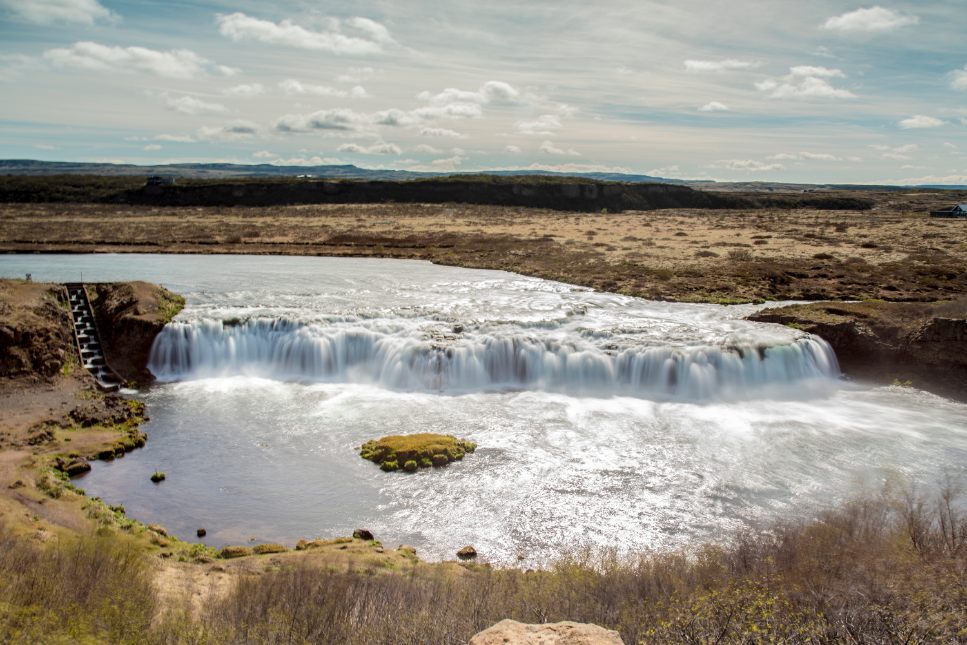
Faxafoss is an underrated stop that most visitors rush past on the way to Gullfoss. It’s a wide, relatively low waterfall on the Tungufljót river — less dramatic than Gullfoss, but far less crowded. Parking costs 900 ISK ($7.40).
There are benches nearby, making it one of the best spots on the route for a picnic lunch. If you’re traveling by camper van, this is an excellent place to use your cooking gear before pushing on to the busier stops.
Gullfoss
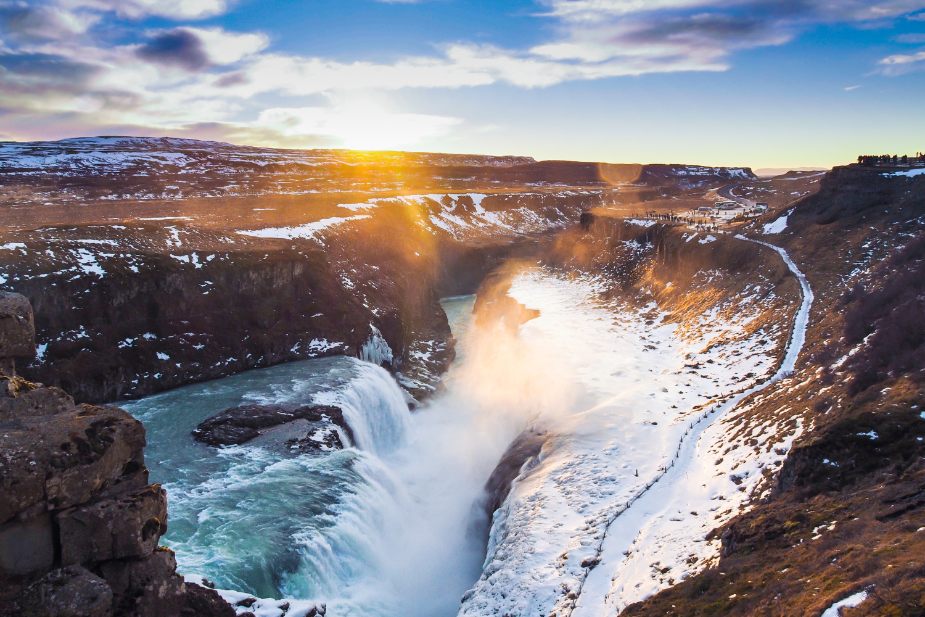
Gullfoss (“Golden Falls”) is one of Iceland’s most powerful waterfalls and a highlight of any Golden Circle itinerary. The Hvítá river drops 32 meters in two dramatic tiers before disappearing into a narrow canyon. The sheer volume of water and the mist that rises from the falls make it spectacular in any season.
There are two viewing platforms, an upper and a lower, connected by a short path. The lower path gets you close enough to feel the spray, but during winter or icy conditions, it may be closed. Always follow posted warnings.
Gullfoss was nearly developed as a hydroelectric power station in the early 20th century; a local farmer’s daughter is credited with campaigning to protect it. Today, it’s one of Iceland’s most visited natural sites.
Parking at both the upper and lower car parks is free. The upper car park is the larger of the two and sits directly next to the visitor center, but spaces fill fast in summer, so arrive early. The lower car park is smaller and less signposted, but offers a slightly shorter walk to the falls.
Geysir Geothermal Area & Strokkur
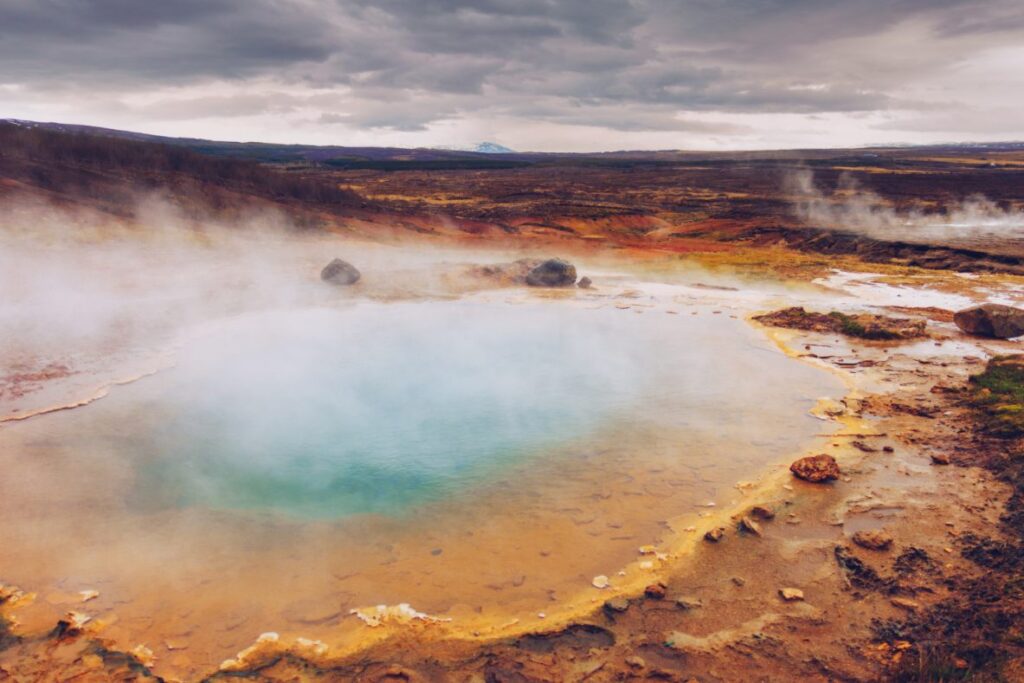
The Geysir area sits in the Haukadalur valley and is home to Iceland’s most reliably active geyser: Strokkur. The original Geysir, which gave the English language the word “geyser”, now rarely erupts, but Strokkur puts on a show every 6 to 10 minutes, shooting boiling water up to 20–40 meters into the air.
A few practical notes:
- Stand upwind of Strokkur before it erupts. The water is scalding.
- Staying on marked paths is both a safety requirement and protects the geothermal crust.
- In addition to Strokkur and Geysir, the geothermal area also contains Blesi, a pair of hot pools that clearly show the temperature difference between geothermal and cooler water.
- The large visitor center at Geysir has a restaurant, café, gift shop, and restrooms. There is also a fuel station located here for a quick refuel.
Laugarvatn
Laugarvatn is the easy-to-miss stop that rewards travelers who pause. This small geothermal town sits on the shores of Lake Laugarvatn, roughly halfway between Geysir and Þingvellir, and makes a natural break in the drive. The Fontana Spa offers geothermal steam baths and hot pools fed directly by springs beneath the lake floor — about as Icelandic an experience as you’ll find on the whole route. If a full spa stop doesn’t fit your schedule, it’s still worth pulling over to stretch your legs and take in the lake views.
Camper van travelers will find a campsite just before the village on the right-hand side, making it one of the most convenient overnight stops on the Golden Circle.
Þingvellir National Park
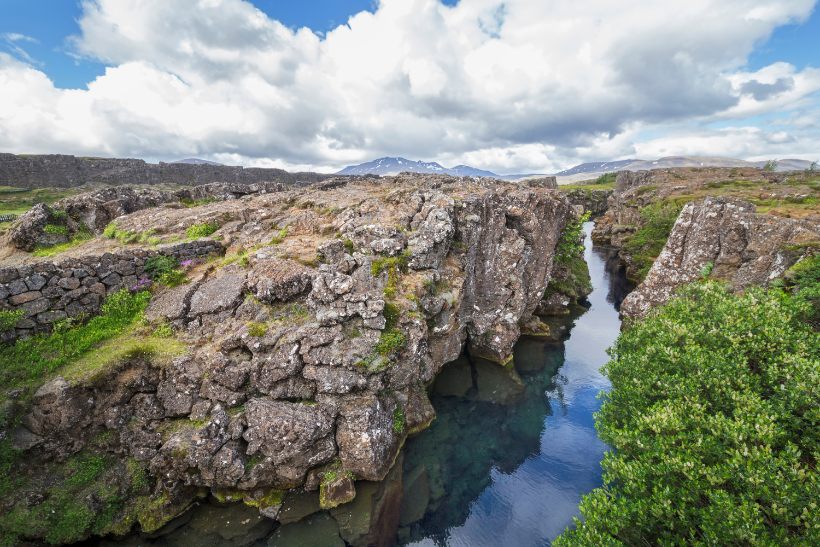
Þingvellir is the most historically and geologically significant stop on the route. It’s a UNESCO World Heritage Site and the location of Alþingi — the Icelandic parliament, founded in 930 AD and considered the world’s oldest. The site sits in a rift valley where the North American and Eurasian tectonic plates are slowly pulling apart, a process visible in the dramatic cliff faces and fissures that run through the park.
A parking fee is collected to cover the cost of operating the parking lots. Expect to pay 1,000 – 1,200 ISK ($8.20-9.30), depending on your vehicle type.
Key attractions within Þingvellir:
- Silfra fissure — One of the world’s top ten diving and snorkeling sites. The glacial meltwater filtered through volcanic rock for decades gives it extraordinary clarity. Snorkeling and diving tours depart from the site.
- Peningagjá (“Coin Fissure”) — A clear water fissure where visitors traditionally throw coins.
- Öxará river and Öxarárfoss waterfall — A short and easy walk from the main parking area.
- Lögberg (“Law Rock”) — The site where the Alþingi’s chieftains once gathered. A flag marks the location.
If you want to hike, Þingvellir has excellent trails through the valley. There’s also a well-equipped campsite if you’re planning an overnight stop.
Optional Detours
Want to add even more to your Golden Circle itinerary? The area south of Laugarvatn and around Route 35 is full of worthwhile detours.
| Detour | Type | Why Go |
| The Secret Lagoon (Flúðir) | Hot springs/relaxation | Quieter and more authentic alternative to the Blue Lagoon; geothermal pool dating to 1891 |
| Skálholt Cathedral | Culture/history | One of Iceland’s most important historical sites; former seat of the Bishop of Iceland |
| Reykholt | Food/geothermal | Small geothermal village; hot pots and local greenhouse produce |
| Sólheimar Ecovillage | Community/culture | Unusual and peaceful stop; community that produces art, crafts, and organic goods |
Driving the Golden Circle by Camper Van
A camper van changes the Golden Circle experience significantly. Instead of racing through to make it back to Reykjavík by dinner, you set your own pace — stop when something catches your eye, cook lunch at Faxafoss, and wake up inside Þingvellir National Park with the valley to yourself before the day-trip crowds arrive.
Practical advantages of a camper van on the Golden Circle:
Food and fuel costs. Eating out in Iceland is expensive. With a camper van from Rent.is, you have a fridge, cooking gear, and storage for groceries. Stock up at a Krónan or Bónus supermarket in Reykjavík before you leave — it’ll save you significantly compared to the tourist center restaurants at Geysir or Gullfoss. Our guide to camper van rental costs helps you to budget for your vehicle.
Flexible timing. Arrive at Þingvellir in the early morning or evening when the light is best, and the crowds are thin. Spend longer at Silfra or take a spontaneous detour to the Secret Lagoon without worrying about a hotel check-in time.
Camping on the route. There are several good campsites along or near the Golden Circle, including at Þingvellir and near Laugarvatn. Always book ahead in the peak summer months. See our guide to campsites in Iceland for up-to-date details.
Extended route potential. Starting the Golden Circle in a camper van makes it natural to extend into the Iceland Ring Road rather than looping back to Reykjavík.
Camper van tips specific to the Golden Circle:
- Fill your tank in Reykjavík or at the Geysir fuel station. There are limited options between stops.
- The Þingvellir campsite has toilet facilities, running water, and electrical hookups. Arrive early in July and August.
- In winter, camper van travel on the Golden Circle is very doable, the roads are paved and regularly maintained, but check conditions daily and carry the right travel apps for Iceland.
- Familiarize yourself with Icelandic road signs before you drive, particularly winter warning signs and one-lane bridge markers.
Compare Rent.is camper vans for Iceland road trips.
Camper Rental Self-Drive Vs Car Rental Self-Drive vs Guided Tour
All three options work for the Golden Circle. The right choice depends on your priorities.
| Option | Best For | Pros | Cons |
| Self-drive camper van rental | Flexible travelers, couples, families, and road trip planners | Full control of timing; cook your own food; overnight option; extends to Ring Road | Requires driving confidence; higher upfront cost |
| Self-drive car rental | Day-trippers, those who prefer hotel stays | Flexible; easy day loop | Back to Reykjavík each night; no cooking facilities |
| Guided day tour | Those who don’t want to drive | Transport and guide included; no navigation required | Fixed schedule; expensive; no flexibility to linger |
For most first-time visitors doing a 5–10 day Iceland trip, a self-drive car or camper van offers better value and more memorable experiences than a guided tour. The Golden Circle roads are well-marked and entirely on paved routes, so confidence requirements are low.
Seasonal & Winter Tips
The Golden Circle is a year-round route, but conditions vary significantly by season.
Summer (June–August)
- Long daylight hours (up to 24 hours in June) mean you can drive at any time of day.
- Crowds are at their peak, especially at Gullfoss, Geysir, and Þingvellir. Start early (before 8 am) to beat tour buses.
- Campsites fill up; always book ahead.
- All roads are open; detours and Highland alternatives are accessible. (Remember, you’ll need a 4×4 if you decide to travel on the Highland F-Roads)
Autumn (September–October)
- Smaller crowds, dramatic light, and early Northern Lights potential.
- Weather becomes more unpredictable; pack layers and waterproofs.
- Campsites begin closing for the season.
Winter (November–March)
- Snow-covered landscapes make for stunning photography, but require caution.
- The paved Golden Circle route remains open and is gritted/ploughed regularly.
- Always check road.is before driving; some viewpoint paths may close due to ice.
- Gullfoss is spectacular in winter — frozen edges, mist, and snow — but the lower viewing platform may be closed.
- Daylight is limited to around 5 hours in December. Plan your route accordingly.
- A 4×4 is not required for the standard route in normal winter conditions, but can give added confidence.
Spring (April–May)
- Snowmelt creates dramatic river conditions.
- Fewer tourists than in summer; campsites start reopening.
Check Iceland’s weather by month to plan what to expect.
Golden Circle FAQs
How many miles is the Golden Circle in Iceland?
The Golden Circle is approximately 140–186 miles (230–300 km), depending on your exact route and any detours you add. The range accounts for different starting points within Reykjavík and optional stops like Kerið and Faxafoss.
How far is the Golden Circle from Reykjavík?
The Golden Circle starts roughly 55 km (34 miles) from central Reykjavík. Following the counterclockwise route we recommend, Kerið volcanic crater is your first stop — about a 45-minute drive south on the Ring Road, then east on Route 35. From there, the loop takes you northeast through Gullfoss, Geysir, and Laugarvatn before finishing at Þingvellir and heading back into the city.
How long does the Golden Circle take?
Most travelers spend 7-9 hours completing the route with stops at the main attractions. If you add Kerið, Faxafoss, Laugarvatn, and optional detours, allow a full day of 8–10 hours, or spread it across two days.
Do you need a 4×4 for the Golden Circle?
No — for the standard Golden Circle route on paved roads in normal conditions, a 4×4 is not required. In winter, a 4×4 offers additional confidence, but the main route is regularly maintained and gritted.
Can you drive the Golden Circle in a camper van?
Yes, and many travelers consider it the best way to do it. A camper van lets you set your own schedule, cook your own meals, avoid expensive restaurant stops, and stay overnight at campsites inside Þingvellir or near Laugarvatn. See our Iceland camper van options for more.
What are the best stops on the Golden Circle?
The three essential stops are Þingvellir National Park, the Geysir Geothermal Area (specifically Strokkur), and Gullfoss waterfall. Kerið volcanic crater and Faxafoss waterfall are excellent secondary stops. For detours, the Secret Lagoon and Laugarvatn Fontana are the most popular additions.
Where can you stay overnight near the Golden Circle?
The main overnight options are the campsite at Þingvellir National Park, campsites near Laugarvatn, and guesthouses/hotels around Selfoss and Flúðir. If you’re traveling by camper van, Þingvellir’s campsite is one of the best-positioned in Iceland. Always check current availability and booking requirements — see our campsites in Iceland guide for details.
With Rent.is, exploring the Golden Circle and beyond has never been easier. If you’re ready to start your adventure, check out our Iceland camper rental options and find the perfect vehicle for your journey.