

A camper van typically costs less than hotels for trips of seven days or more in Iceland, and offers flexibility no hotel can match. But there can be situations where a hotel makes sense, such as winter travel without a heated vehicle, for families with young children, and for trips under five days. Most experienced Iceland travelers end up mixing both.
Iceland forces a decision most trips never require. You’re booking accommodation for a country where the Ring Road loops around the island, but many of the best detours sit beyond it. Campsite conditions can change day to day, and the best
moments often happen while you’re already moving: a sudden aurora, an unplanned waterfall stop, or a quiet geothermal pool with no one else around.
The camper van vs hotel debate in Iceland isn’t abstract. It comes down to your trip length, the season you’re traveling in, who’s coming with you, and how you personally respond to the idea of sleeping in a van when it’s 2°C outside.
We rent out camper vans for a living, so you might expect us to argue campers win every time. We don’t necessarily think that’s true. Here’s how we’d actually talk through the decision.
Trip length is the real deciding factor
No other variable matters more than how many nights you’re staying.
For fewer than three nights, a hotel is often the more sensible choice. You’re spending more time getting oriented than you are exploring — and the cost savings that make a camper van attractive over a week don’t have time to compound. A three-night Reykjavík trip with a day tour or two typically doesn’t need a van.
At seven nights or more, the economics flip. Hotel costs in Iceland average $313/night for a standard double room, with summer peaks hitting $456/night in August (budgetyourtrip.com, based on 530 hotel data points). At those rates, a seven-night hotel stay runs $2,191–$3,192. A camper van rental, campsite fees, and groceries across the same seven nights comes in well under that — often by $500–1,000 depending on your vehicle choice and how much you cook.
At ten to fourteen nights — the Ring Road window most travelers aim for — the camper van advantage becomes significant.
When a camper van is the better choice
The flexibility argument
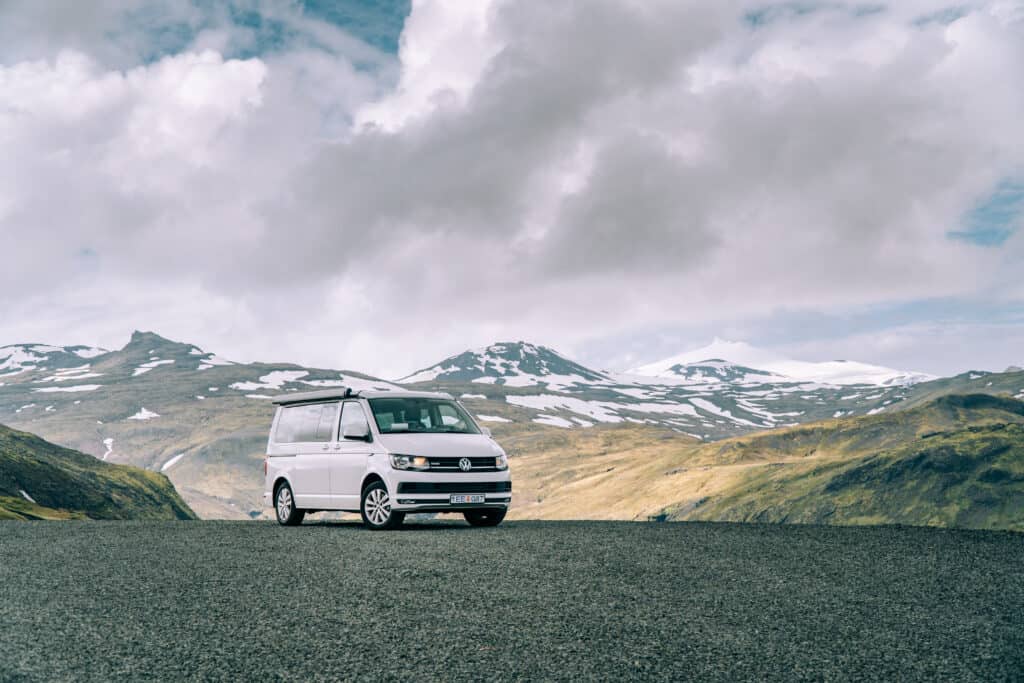
Iceland’s best experiences are not bookable in advance. The aurora only shows when the sky cooperates. The Highland roads open and close depending on weather conditions. The campsite at Vestrahorn has one field — it’s first-come, first-served and either has space, or it doesn’t.
A hotel itinerary locks you into a sequence of locations two or three months before you arrive. A camper van allows you to make every decision the night before, or that morning. You can spend an extra day at Jökulsárlón because the light is extraordinary, and just move your sleeping situation with you.
That’s not a minor perk. For many people, it’s the entire point. Browse our full camper van fleet to see the range of options built specifically for Iceland’s conditions.
The cost case for longer trips
Let’s use a seven-day trip as the baseline, two adults:
| Cost | Camper van | Hotel |
| Accommodation | ~$700–900 (vehicle + campsites) | $2,200–3,200 |
| Food | ~$350 (self-catering + some meals out) | ~$770–1,050 ($110–150/day eating out) |
| Fuel | ~$150–200 (Ring Road portion) | ~$150–200 (same driving) |
| Total estimate | ~$1,200–1,300 | ~$3,120–4,450 |
The Camping Card 2026 is worth knowing about. For approximately $204, you can access 40+ campsites across Iceland for up to 28 nights. The card is valid through September 15 of the year of purchase and includes up to two adults and four children under 16. If you’re doing a two-week Ring Road loop and cooking most of your meals, that single card pays for most of your accommodation.
Campsite fees without the card run $17–29 per person per night. Factor that into shorter trips where the card isn’t worthwhile.
For a full breakdown of what to budget for Iceland, our Iceland trip cost guide has current figures across every major spending category.
When a hotel could be the right call
Families with young children
This is one of the few scenarios where hotels may be the easier choice.
Camper vans can work brilliantly for families who enjoy a bit of flexibility and adventure, especially when children are comfortable with shared sleeping space, changing routines, and being outdoors for much of the day. For couples, groups of adults, and families with older children, that freedom is often the whole appeal.
With very young children, the calculation can be different. A two-year-old with a fixed nap schedule, a five-year-old who struggles to settle in a sleeping bag, or an overstimulated child who needs a quiet room and a proper bed can make van life feel harder than expected.
The same logistics that feel freeing to adults — choosing a campsite, cooking in a compact kitchen, planning restroom stops, and adjusting plans as you go — can become more demanding when you’re also managing tired children. Some families love the experience and make it work happily. Others find that hotels give them the structure they need.
If your children are 8–12 and genuinely excited by the adventure, a camper van can be a fantastic way to explore Iceland together. With under-6s, think carefully about your family’s routine, sleep needs, and appetite for flexibility before deciding.
Winter travel without a heated camper van
In January 2023, a traveler on Reddit (several) described booking a camper van for a winter trip without verifying the heating spec. The vehicle had no onboard heating system. They made it two nights before the cold became genuinely dangerous — near-hypothermia conditions — and moved to a guesthouse for the rest of the trip.
This story gets repeated in Iceland travel communities every winter because it keeps happening.
The rule is simple: if you’re traveling between November and March, only book a camper van that explicitly confirms onboard heating. Several of the Rent.is camper vans come equipped with heating systems designed for Iceland’s conditions, but if you’re comparing providers, verify this before you book, not after you land.
Beyond the heating question, winter driving in Iceland often requires a 4×4. The F-roads are closed, but even main roads can turn icy in hours. Our 4×4 camper van range is purpose-built for winter conditions — but if you’re not comfortable with winter driving and you’re not planning to use the vehicle primarily as a mobile basecamp, a hotel in Reykjavík with day tours might be the better option for you.
For more on planning a Ring Road trip including season-specific logistics, our Ring Road guide covers current road conditions and driving times.
Short trips and city-focused itineraries
For two or three nights, especially if you’re staying mostly in Reykjavík with perhaps a day trip around the Golden Circle, hotels can be the simpler choice. The city is walkable, airport transfers are straightforward, and you won’t lose time adjusting to the practicalities of traveling with a larger vehicle.
A camper van can still work if the road trip itself is the point of your visit, but the value is usually clearer when you have more time to move between regions, stay close to the landscapes you came to see, and make use of campsite flexibility.
For a short Reykjavík-focused break, review hotel options. For a longer trip built around the road, a camper van starts to make much more sense.
Large groups
Motorhomes sleep four to six people and change the cost math considerably — but the driving and parking logistics scale with size. For groups of seven or more, a combination of hotels and a motorhome for some members is often easier to manage than trying to coordinate multiple vehicles or cram everyone into one.
Our motorhome rental page has specs on capacity and pricing for larger groups.
The hybrid approach — what experienced travelers actually do
Ask someone who has done Iceland multiple times how they’d structure a trip, and a lot of them land on the same answer: start in Reykjavík, pick up the van, do the Ring Road in a camper van, drop the van, spend the last night in a hotel.
One couple (from Reddit) described it this way: they’d done three Iceland trips — the first entirely in hotels, the second entirely in a camper van, and the third a mix. The husband preferred the van for the Ring Road section. The wife said she’d have taken hotels the whole way if it had been up to her, but acknowledged the camper van made the Midnight Sun night at Jökulsárlón possible in a way a hotel never would have been. The hybrid was the version they both found acceptable.
That compromise structure works well for a lot of travelers. Opening and closing nights in a hotel let you use your arrival and departure days more wisely. Instead of heading straight from the airport into the driving portion of the trip, or squeezing in a final pack-up before your flight, you can collect and return the camper van at a point that fits naturally into your itinerary. The middle section — the actual driving portion — is where a camper van really earns its keep.
The hybrid also works seasonally: base yourself in Reykjavík hotels for the first two nights, then take the camper van into the Snæfellsnes peninsula or the South Coast for four or five nights, then return. It’s a more manageable introduction to Iceland van life than landing and immediately driving the full Ring Road.
For the best campsites along the Ring Road and South Coast routes, our Iceland campsites guide has site-by-site recommendations with facilities notes.
The honest cost comparison
Here’s how the numbers work across different trip lengths, based on current 2026 rates:
| Trip length | Camper van total est. | Hotel total est. | Camper van saves |
| 3 nights (2 adults) | $600–750 | $940–1,400 | $340–650 |
| 7 nights (2 adults) | $1,200–1,500 | $3,120–4,450 | $1,600–3,000 |
| 14 nights (2 adults) | $2,000–2,600 | $5,800–8,400 | $3,200–5,800 |
Notes on methodology: Hotel figures based on average $313/night for a mid-range double, with summer adjustment to $380/night for July–August. Camper van figures include vehicle rental, Camping Card or per-night site fees, and a self-catering food budget with occasional restaurant meals. Fuel costs assumed identical (same driving either way). Exchange rate applied at ISK 218.51/liter ($1.73/liter) for gasoline as of June 2026 — globalpetrolprices.com.
View our full fleet and pricing →
The savings on longer trips are substantial. But they assume you’re actually cooking in the van, using campsites rather than paying for powered hookups at every stop, and not offsetting the savings with daily restaurant meals. A camper van trip where you eat out every meal is not materially cheaper than hotels — you’re just trading bed comfort for freedom of location.

What to ask before you book
Before committing to either path, these are the questions that actually matter:
For a camper van:
- Does the vehicle have onboard heating? (Critical for October–April)
- Is it 4×4? (Needed for F-roads and serious winter driving)
- What’s included in the insurance? What does the gravel protection cover?
- What’s the pickup and drop-off location? (Rent.is operates from a base five minutes from KEF with a 24/7 free shuttle)
- What’s the fuel policy?
For hotels:
- How much do you value flexibility vs. having a confirmed place to sleep?
- Are you comfortable with the dining costs? Iceland’s restaurants are expensive. Self-catering at a hotel is possible but limited.
- If your plans change, can you move your bookings?
For either:
- When are you traveling? Winter and shoulder season change the calculus significantly.
- Who’s coming? A couple traveling together handles van life very differently than a family with three kids under eight.
Frequently asked questions
Is a camper van cheaper than hotels in Iceland?
For trips of seven nights or longer, yes — significantly. A camper van with campsite fees and self-catering food runs roughly $1,200–1,500 for a seven-day trip for two adults. Hotels alone at average Iceland rates cost $2,200+ for the same period, before adding three meals a day. On shorter trips (two to three nights), the savings are smaller; the real bonus is the freedom you get.
Is a camper van comfortable enough for two weeks in Iceland?
For most adult travelers, yes — provided you choose the right vehicle size. Compact camper vans are genuine two-person setups with a proper sleeping area, kitchen, and storage. Mid-size vehicles add standing room and more kitchen space. The main adjustment is that you’re living out of a smaller footprint than a hotel room, which some travelers love, and others find claustrophobic within a few days. If you’re not sure, a seven-night trip is a better first test than two weeks.
Can you just use hotels in Iceland and still see the main sights?
Absolutely. The Golden Circle, South Coast, and Snæfellsnes Peninsula are all accessible from hotel bases, with day tours or self-drive. The Ring Road is harder — completing it in hotels requires booking multiple properties in sequence, which limits flexibility and doesn’t save money over a camper van. Hotels are a fine choice for region-based itineraries; camper vans suit circuit itineraries better.
What’s the best option for Iceland in winter?
A heated 4×4 camper van or hotels, depending on your comfort with driving conditions and cold. Winter van life in Iceland is genuinely viable if you have a properly equipped vehicle — but it’s not the right choice for everyone. The darkness, cold, and road variability mean you need more contingency built into each day than a summer trip. If you book a camper van for winter, verify that it has onboard heating before you confirm.
How does the Camping Card work?
The Iceland Camping Card 2026 costs $204 and covers 28 nights at 40+ participating campsites across the country, valid until September 15. It covers up to two adults and four children under 16. For families or couples doing a Ring Road loop of 10–14 nights during summer or shoulder season, it’s one of the better value purchases available. Sites not covered by the Card charge €15–25 per person per night directly.
Is it safe to sleep in a camper van in Iceland?
Yes, at designated campsites. Wild camping (outside marked sites) is restricted in Iceland and not recommended — designated sites have facilities, security, and often better locations anyway. In summer, Iceland has 200+ campsites open across the country, with sites roughly every 100–150 km along the Ring Road. In winter, the number of open sites drops considerably, which is one more reason winter camper vanning requires more planning than a summer trip.
What if I want some hotel nights and some camper van nights?
That’s exactly what a lot of experienced Iceland travelers do. A common structure: hotel in Reykjavík for the first and last nights, camper van for the Ring Road or specific regional routes in between. You can pick up and drop off the vehicle at the same location, so the logistics are straightforward. There’s no requirement to commit to one or the other for the entire trip.