
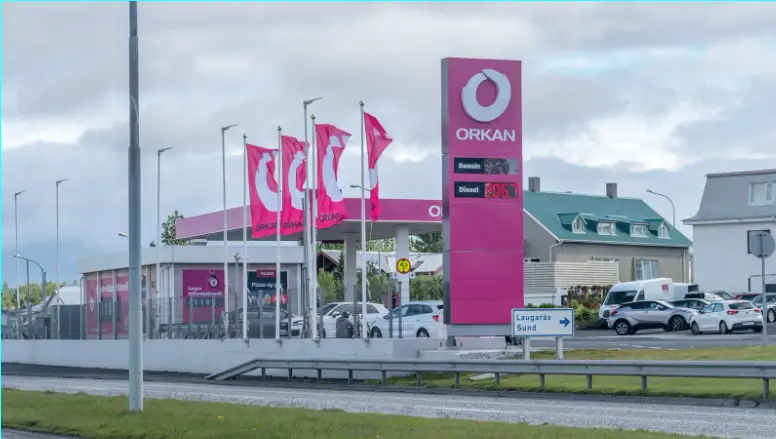
In 2026, Iceland pump prices sit around 215–225 ISK ($1.73-1.81) per liter for petrol and 235–252 ISK ($1.89-2.02) per liter for diesel — noticeably lower than previous years. That’s because Iceland moved road tax off the pump and onto a per-kilometer charge from January 1, 2026. You pay less at the station, but there’s now a separate kílómetragjald fee collected by your rental company.
Iceland is one of the more expensive countries in the world to fill a tank. The island imports all its fuel, infrastructure is spread thin across a small population, and until recently, the pump price included a chunk of road maintenance tax on top of everything else. If you’re planning a camper van trip this year, it’s worth understanding exactly what you’ll pay and why.
This guide covers current prices, the 2026 road tax reform, what you need to know at an Icelandic self-service pump, which station chains and apps save you money, where fuel gaps can strand you, and what to expect if you’re renting one of our plug-in hybrid camper vans.
What’s Gas Costing Right Now?
As of mid-2026, average pump prices across Iceland sit in these ranges:
| Fuel type | ISK per liter | Approx. USD per liter | Approx. USD per gallon |
| Petrol (bensín / unleaded) | 215-225 ISK | ~$1.73-$1.81 | ~$6.55-6.85 |
| Diesel (dísel) | 235-252 ISK | ~$1.89-$2.02 | ~$7.15-7.65 |
Prices fluctuate from week to week and differ by chain — Costco in Reykjavík consistently undercuts the national chains by a small margin, while remote stations in the Westfjords and East Fjords may run slightly higher. Before you set off, check Gasvaktin — Iceland’s live fuel price tracker, updated continuously across all chains.
These prices are materially lower than in 2025. In previous years, pump prices hovered around 300 ISK per liter for petrol. What changed is covered in the next section.
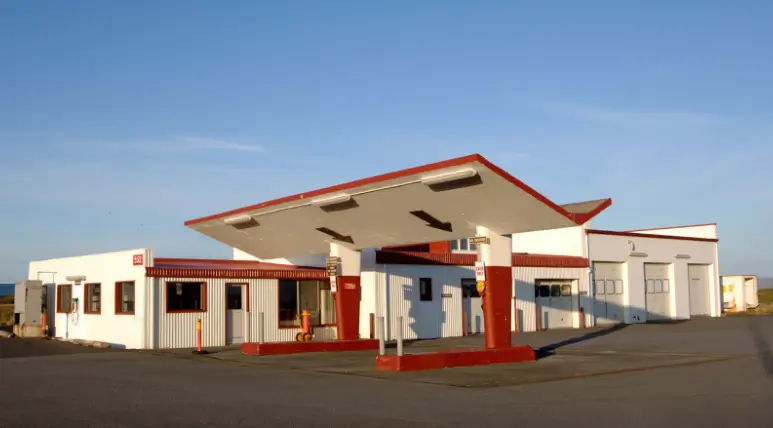
The 2026 Road Tax Change — What It Means for Your Budget
As of January 1, 2026, Iceland restructured how it taxes road use. For decades, road maintenance costs were bundled into the price of petrol and diesel at the pump. It worked well when almost everyone drove combustion vehicles — more driving, more fuel, more tax revenue. But as electric vehicles and plug-in hybrids became common, drivers using the roads heavily were contributing less to road funding. The system needed updating.
Iceland’s solution is the kílómetragjald, a per-kilometer road usage charge, set at 6.95 ISK (~$0.06) per kilometer for passenger vehicles under 3,500kg.
What this means in practice: The road tax component was stripped out of fuel prices (explaining the drop from ~300 ISK to ~215–252 ISK per liter), and you now pay separately for every kilometer you drive.
For rental car customers: Your rental company handles this on your behalf. Most apply one of two approaches — either a flat daily rate (based on an average daily driving distance calculation), or a per-kilometer charge settled from odometer readings at vehicle return. Either way, you’ll see this itemized clearly in your agreement.
Please note: At Rent.is, road tax is charged at a daily rate of 1,550 ISK (~$12.44).
The question is, does this make Iceland more or less expensive for tourists overall? On a typical Ring Road trip of around 1,332 km, the km-tax adds roughly 9,257 ISK (~$74) to your total costs — while the fuel saving compared to pre-2026 prices is notable, with a 60-liter tank now costing around 14,000 ISK instead of ~18,000 ISK. For most camper van travelers, the overall change is minimal: the exact balance will depend on your route, vehicle, and fuel consumption, and costs can vary accordingly. But the km-tax is nothing to worry about — it’s unlikely to make a significant difference to your total trip costs.
How Much Will Fuel Cost for Your Whole Trip?
Here’s a rough budget guide based on common Iceland road trip routes. These figures use 240 ISK/liter as a working average for diesel (mid-range of current prices) and a typical camper van consumption of 9–10 liters per 100 km.
| Route | Distance | Diesel liters needed | Estimated fuel cost (ISK) | Estimated fuel cost (USD) |
| Ring Road (Route 1) | ~1,332 km | ~126 liters | ~30,000 ISK | ~$241 |
| Golden Circle + South Coast | ~300 km | ~28 liters | ~6,700 ISK | ~$54 |
| Reykjavík to Höfn (one way) | ~460 km | ~43 liters | ~10,300 ISK | ~$83 |
| Reykjavík to Akureyri (one way) | ~390 km | ~37 liters | ~8,900 ISK | ~$72 |
Add the km-tax on top: at 6.95 ISK/km, the Ring Road adds ~9,257 ISK (~$74) to the total.
For Jeep Wrangler 4XE or Renegade 4XE renters running in hybrid mode, consumption improves considerably — particularly on the stretches in and around Reykjavík where the battery handles most of the load. More on PHEV trip economics further down.
A useful planning rule: budget around 25,000–35,000 ISK in fuel for a Ring Road trip in a mid-size diesel camper van, plus the km-tax. Check the Iceland trip cost guide for a full breakdown of what to budget across all trip expenses.
Filling Up — What You Need to Know at the Pump
Self-service is the default everywhere
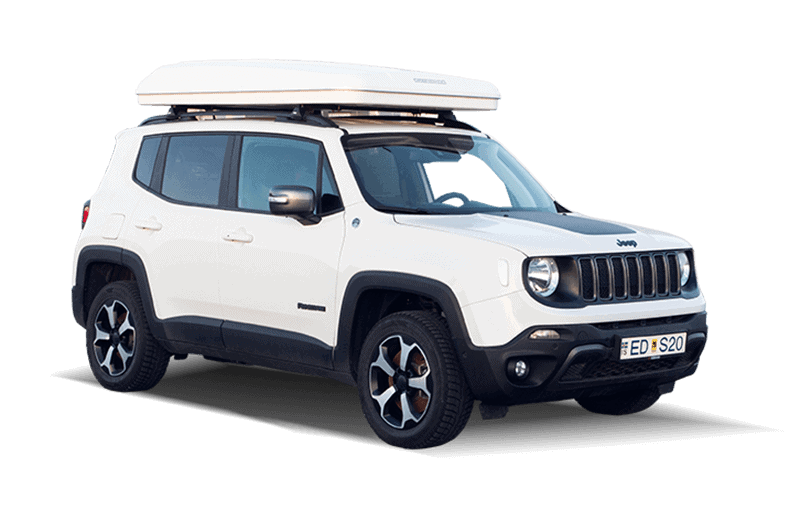
The vast majority of Iceland’s fuel stations are fully automated and unmanned, 24 hours a day. There’s no attendant. You pull up, insert your card, punch in your PIN, select a fuel amount, and fill. That’s the whole process.
A few staffed stations exist in larger towns and at some N1 locations, but don’t assume a station will have anyone working there — including in the middle of Reykjavík.
Your card must have a PIN. Signature-based credit cards do not work at Icelandic pumps. If your card requires a signature rather than a four-digit PIN, you won’t be able to pay. Most US, UK, and European cards issued in the last decade work fine, but check before you arrive. Apple Pay and contactless payments are generally accepted at both indoor and self-service gas stations.
Pre-authorization holds are large. When you insert your card, the station places a temporary hold on a significant sum — often far more than the value of your fill-up:
| Station | Pre-authorization hold |
| N1 | 22,000 ISK (~$177) |
| Olís | 30,000 ISK (~$241) |
| Orkan | 30,000 ISK (~$240) (depending on your bank) |
| Costco | 20,000 ISK (~$161) |
This is not a charge — it’s an authorization check. The actual fuel cost is all that’s charged, and the hold drops away within 2–5 business days, depending on your bank. The practical problem: if you’re running close to your credit limit, large holds at multiple stations can create issues mid-trip. Leave headroom on your card.
Prepaid debit cards often fail. Many travelers carry prepaid travel cards with limited balances. These regularly get declined at Icelandic pumps because the pre-authorization amount exceeds the card balance. Use a standard credit card with a PIN.
Know your fuel — it’s color-coded
Getting this wrong is expensive. At Icelandic stations:
• Green nozzle: bensín — petrol/gasoline (unleaded)
• Black nozzle: dísel — diesel
• Yellow nozzle (where present): AdBlue additive
If you’re renting a diesel camper van — which most of our fleet runs on — you want the black nozzle. Double-check your vehicle rental agreement if you’re not sure. Misfueling means a tow and a fuel flush, which is a long, costly delay.
Station chains at a glance
| Chain | Network size | Coverage | Discount program |
| N1 | 100+ stations | Nationwide, including many remote locations | Prepaid cards of 3,000, 5,000, or 10,000 ISK ($24, $40, or $80); app loyalty program |
| Orkan | ~50 stations | Reykjavík, South Coast, and Ring Road | App-based 12 ISK/liter discount via Apple Wallet or Google Wallet |
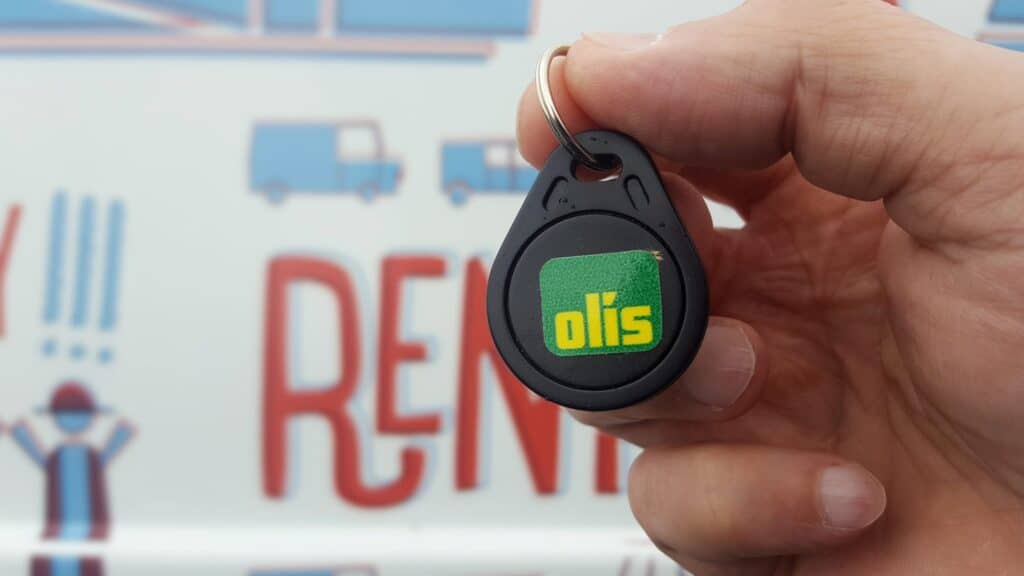
| Olís | ~50 stations | Nationwide | Key tag offers a 7 ISK/liter discount as well as restaurant discounts |
| Costco | 1 station | Reykjavík only | Membership required; usually among the lowest per-liter prices in the capital |
| ÓB | Various | Urban and semi-urban areas | Key tag offers a 7 ISK/liter discount as well as restaurant discounts |
N1 has the widest reach and is your default option for remote routes. Their prepaid cards (available in 3,000, 5,000, or 10,000 ISK denominations) are useful if you’re traveling with a card that sometimes struggles at unmanned pumps, or if you want to budget a fixed fuel spend.
Orkan offers the best per-liter savings if you set up their app before you travel — see Loyalty Cards and Apps, below, for the details.
Costco in Reykjavík consistently posts the lowest per-liter price in Iceland. If you’re picking up from KEF and your route takes you through Reykjavík before heading out, it’s worth a stop — but you need an active Costco membership to fill up there, and it’s only one location in the country, so it’s not a usable option once you leave the capital.
Useful apps
Gasvaktin (also available as GSMbensín) shows live prices at every chain across Iceland, updated in real time. Filter by fuel type and sort by cheapest. If you want to know whether the N1 or the Orkan station in Akureyri is cheaper that day, this is where you check. It’s free and works well on Icelandic data or WiFi.
Remote Routes — Don’t Get Caught Short
Iceland’s Ring Road passes through some genuinely isolated terrain. Most of the country has good fuel coverage, but two regions — the East Fjords and the Westfjords — require specific planning.
East Fjords
The longest fuel gap on the entire Ring Road is on the eastern section. Between Kirkjubæjarklaustur heading east and Höfn, the distance is approximately 205 km with no fuel stop along the way — the longest gap on the entire Ring Road. Then, from Höfn, continuing east to Djúpivogur is another 166 km.
The rule here is simple: fill to 100% at Kirkjubæjarklaustur before heading east. Don’t leave with less than three-quarters of a tank at any point in this region. Stations exist in Höfn, Djúpivogur, and Neskaupstaður, but rely on exactly those — don’t assume you’ll find anything in between.
Westfjords
The Westfjords have fuel stations in Ísafjörður, Bolungarvík, Hólmavík, and Patreksfjörður, but the roads between them involve significant distances and winding terrain. Gaps between stations run to 150 km or more, and many of the routes add time that fuel consumption estimates don’t account for.
The local advice that applies: never let the tank drop below half in the Westfjords. Fill at every station you pass, regardless of how much fuel you think you have left.
For specific route guidance before heading into either region, read our East Iceland travel guide and Westfjords travel guide.
Loyalty Cards and Apps — Are They Worth It for Renters?
Short answer: yes, if your trip covers more than a few hundred kilometers.
Orkan app — the most useful for tourists. Download and register before you arrive, add the digital card to your Apple or Google Wallet, and tap to pay at the pump. You get 12 ISK off per liter at most Orkan stations (excluding a handful of already-discounted Reykjavík locations), and there’s no pre-authorization hold. On a full Ring Road trip with 125+ liters of fill-ups across 3–4 Orkan stations, that discount saves you roughly 1,500 ISK (~$12.05) with minimal effort.
N1 prepaid cards — practical rather than discounted. The prepaid cards don’t offer a per-liter discount, but they work reliably at N1 self-service pumps and are useful if you’re concerned about your card’s PIN functioning abroad or about large pre-authorization holds depleting your available balance. Available in 3,000, 5,000, and 10,000 ISK denominations at staffed N1 stations.
Iceland Camping Card fuel discount — the Iceland Camping Card provides access to 47+ campsites across the country and includes a fuel discount at participating stations. If you’re already using the Camping Card for accommodation, check the current partner list for fuel savings.
Verdict for renters: Download the Orkan app before you fly. It’s the single easiest saving, and it works from day one.
PHEV Camper Vans — Charging in Iceland
Rent.is offers two plug-in hybrid camper vans: the Jeep Wrangler 4XE and the Jeep Renegade 4XE. Both run on a petrol engine with a battery-assisted hybrid drivetrain, meaning they can cover short distances on electric power alone before the combustion engine takes over.
For Iceland road trips, this hybrid architecture works particularly well in and around Reykjavík, on the South Coast, and on the stretches of the Ring Road near population centers where charging infrastructure exists. In remote areas — the Highlands, deep Westfjords, East Fjords — you’ll operate primarily on petrol, just like any other vehicle.
Iceland’s charging network
Iceland’s main public charging networks are ON Power and Ísorka, with N1 also expanding its fast-charging footprint. Charging coverage follows population density: Reykjavík and the surrounding area have excellent coverage, with chargers widely available on the South Coast and at Ring Road towns including Selfoss, Vík, Höfn, Akureyri, and Mývatn.
Fast (DC) charging costs approximately 65–75 ISK (~$0.52-0.60) per kWh with ON Power and around 70 ISK (~$0.56) per kWh with Ísorka. AC charging runs considerably cheaper at around 20–30 ISK (~$0.16-0.24)per kWh.
At 70 ISK per kWh, charging the Jeep Renegade 4XE’s 11.4 kWh usable battery costs roughly 800 ISK (~$6.43) for a full charge — good for around 40–50 km of electric driving before the petrol engine picks up.
Practical tips for PHEV renters
Start with a full charge at KEF. Charge again whenever you reach Reykjavík, Selfoss, Akureyri, or other larger towns. The Ísorka and ON apps both show charging locations and live availability — download one before you travel.
Don’t count on charging in the Highlands (F-roads and central Iceland) or in the deep Westfjords. In these areas, plan fuel as you would for any combustion vehicle. The PHEV’s petrol range gives you full flexibility.
The per-kilometer road tax applies to PHEV campervans just as it does to diesel vehicles. Your rental agreement will specify the collection method.
Diesel or PHEV — A Quick Fuel Planning Guide
Choosing between a diesel camper van and a PHEV comes down to your route and priorities.
Diesel camper vans (the majority of our fleet) offer straightforward fuel planning — fill up at any station carrying a black-nozzle pump, which is nearly all of them. Excellent range per tank, simpler for remote routes, and no charging logistics to manage.
PHEV campervans (Wrangler 4XE, Renegade 4XE) offer lower running costs in and around populated areas, meaningful EV range for daily driving segments, and the added benefit of 4×4 capability when you need it. Best suited for Ring Road travelers spending time in Reykjavík, the South Coast, and the Golden Circle area. Less ideal as the primary vehicle for a Westfjords-heavy or Highland-only itinerary.
For trip planning, our driving in Iceland guide covers road conditions, F-road access, and what to expect across different regions of the country.
FAQs
Can I pay by card at every gas station in Iceland?
Yes — virtually all Icelandic fuel stations are self-service and card-only, and they accept foreign cards from the US, UK, EU, Australia, and most other countries, provided the card has a chip and a four-digit PIN. Signature-only or magnetic-stripe-only cards won’t work at the pump. Contactless and Apple Pay/Google Pay are generally accepted too. Prepaid debit and travel cards frequently get declined, since the pump’s pre-authorization hold often exceeds the card’s balance — a standard credit card with a PIN is the safer bet.
Some travelers report that cards from digital banks like Revolut or Wise tend to work reliably and show the hold and its release quickly in-app.
Is gas more expensive in Iceland than the rest of Europe?
Yes, broadly. Post-2026 pump prices of around 215–252 ISK per liter translate to roughly $1.73–$1.81 per liter or about $6.55–$6.85 per gallon — higher than most of continental Europe and significantly higher than the US. Iceland’s prices reflect full import costs, a small domestic market, and geographic remoteness. The 2026 km-tax reform reduced pump prices from around 300 ISK, but the km-tax adds back to total driving costs.
What happened to Iceland gas prices in 2026?
From January 1, 2026, Iceland removed road maintenance tax from the pump price and replaced it with a per-kilometer kílómetragjald charge of 6.95 ISK per km. The result: pump prices dropped from roughly 300 ISK per liter to 215–252 ISK per liter depending on fuel type. Tourists pay the km-tax through their rental company, either as a flat daily fee (~1,550 ISK/day) or per-kilometer at vehicle return.
Is diesel cheaper than petrol in Iceland?
No — diesel runs slightly more expensive. Petrol typically sits around 215–225 ISK ($1.73-1.81) per liter, while diesel is closer to 235–252 ISK ($1.89-2.02) per liter. However, diesel engines are more fuel-efficient, so total trip fuel costs for a diesel campervan are generally competitive with or lower than a petrol vehicle covering the same distance.
How do I find the cheapest gas station near me in Iceland?
Use Gasvaktin — it shows live prices at every chain across Iceland, sortable by cheapest and filterable by fuel type. For regular savings, the Orkan app gives 12 ISK off per liter at most Orkan stations without needing to check prices first.
Can I charge a PHEV camper van at Icelandic campsites?
Some campsites have standard 230V electrical hookups that a PHEV could use at a slow charge rate. However, dedicated EV/PHEV charging points at campsites are still limited. Plan charges at public ON Power or Ísorka stations in towns. The Ísorka app and ON app both map charging locations in real time and show live availability.