
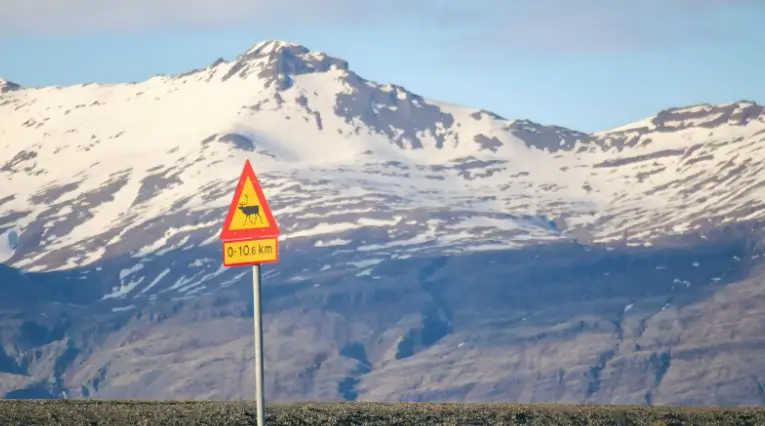
Iceland road signs are mostly symbol-based, but a few Icelandic words and route warnings matter before you set off. The signs that deserve the most attention are the ones that tell you to slow down for gravel, animals, blind hills and one-lane bridges, as well as signs that affect whether a route is open or suitable for your vehicle.
If you are planning a camper van trip, signs are part of route planning. They can tell you when to reduce speed, yield, stop, check current conditions, or choose a different route. This guide focuses on the signs tourists are most likely to meet on rural roads, the Ring Road, and routes near the Highlands.
Quick answer: What do Iceland road signs mean?
Iceland traffic signs use familiar symbols for warnings, restrictions, directions, and services. Some signs also use Icelandic words. Learn the warning signs for gravel, livestock, wind, blind rises, and one-lane bridges first. Then treat F-road and closure signs as a route check: GPS is useful, but a physical sign or official road-condition notice always takes precedence.
- Road Sign System in Iceland
- Warning signs
- Gravel roads
- One-lane bridges
- F-roads
- Closures
- Icelandic terms
- FAQs
The road sign system in Iceland explained
Icelandic road signs fall into seven categories, consisting of: warning, priority, prohibitory, mandatory, direction, information, and service. You don’t need to memorize every category before your trip. The practical question is what the sign asks you to do next.
Iceland road signs and meanings
| Sign type | What it usually tells you | What to do |
| Warning sign | A hazard is ahead | Slow down before the hazard and look for the specific risk. |
| Priority sign | Who should give way | Ease off early, read the situation, and yield if you are unsure. |
| Prohibitory or mandatory sign | What you cannot do or must do | Follow it. It is not a suggestion. |
| Direction or service sign | Route, destination, or facilities | Use it to plan fuel, food, campsites, and rest stops. |
Warning signs you will see most often in Iceland
Warning signs are generally yellow triangles with a red border and a black symbol. They are there to give you time to change your speed or position before the hazard, not after you are already in it.
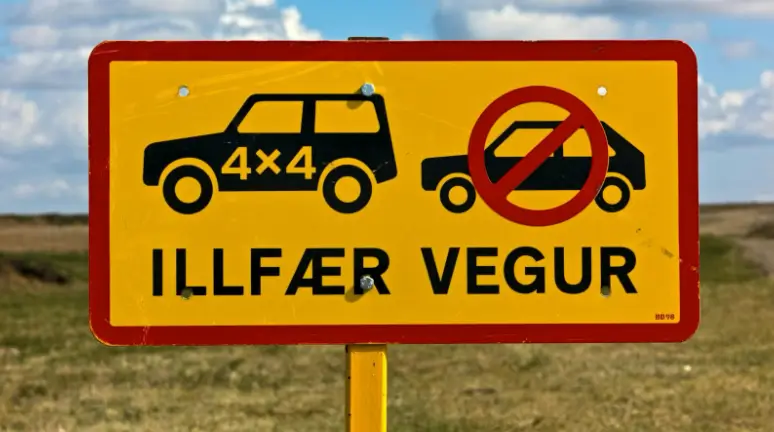
Important warning signs for tourists
| Sign | Where you will see it | What to do |
| Sheep/livestock or wildlife | Rural roads and open farmland | Animals can move into the road without warning. Slow down and watch both sides of the road. |
| Loose gravel | Rural routes, roadworks, and paved-to-gravel transitions | Braking and steering change quickly. Reduce speed before the surface changes. |
| Slippery road or ice | Winter, shaded roads, and exposed areas | Grip can disappear quickly. Slow down and avoid sudden braking or steering. |
| Narrow road or blind rise | Older rural roads and rolling terrain | You may not see approaching traffic. Stay in lane and reduce speed before the crest. |
| Steep descent | Mountain and coastal roads | Control matters before the hill. Lower your speed before the descent. |
| Crosswinds | Exposed stretches and open areas | Gusts can affect handling and doors. Slow down and reassess exposed routes if conditions worsen. |
| Falling rocks or debris | Mountain cuttings and cliffside roads | Debris can land on the road with no warning. Watch the rock face ahead and be ready to brake or steer around it. |
Driving on gravel roads: what “Malbik Endar” means
Gravel roads are common outside towns and away from the main paved routes. A surface change can feel minor when you are looking at a map, but it changes braking distance, steering response, visibility, and the amount of space you need around other vehicles.
“Malbik Endar” means “paved road ends.” You’ll see this sign where pavement changes to gravel. When you spot it:
- Reduce speed before the transition.
- Slow down before curves and blind hills.
- Keep a larger gap between vehicles.
- Take extra care when meeting or passing traffic — stones and dust can be thrown up.
- Don’t assume a gravel road suits every vehicle or every season.
Speed limits and the wider driving rules are covered in our Iceland speed limits and driving laws guide.
One-lane bridges and priority signs
One-lane bridges are common enough that first-time visitors should know what to expect before their first rural driving day. “Einbreið brú” means “single-lane bridge.”
Slow down well before the bridge, look for oncoming traffic, and check whether another vehicle is already entering. SafeTravel advises that the vehicle closer to the bridge has priority, but the sensible approach is to assess the situation and yield if you are uncertain. Cross only when the bridge is clear, and never stop on it for photos.
If your route includes long rural days, our Iceland Ring Road guide can help you plan them realistically.
Iceland F-road signs and mountain-route warnings
F-roads are mountain roads in the Highlands, marked with an F before the road number. They are not simply a more scenic version of a standard route. Conditions, seasonal openings, and vehicle restrictions all matter.
Not every Iceland route needs a 4×4. But if your plan includes F-roads or the Highlands, check the current road status, confirm that your rental is approved for the route, and do not continue on a road that is closed or not permitted for your vehicle. Off-road driving is illegal in Iceland, and it is not the same as driving an open F-road.
For the detail behind that decision, read our guide to driving the Highlands in Iceland. If F-roads are genuinely part of your plan, compare 4×4 camper rentals in Iceland.
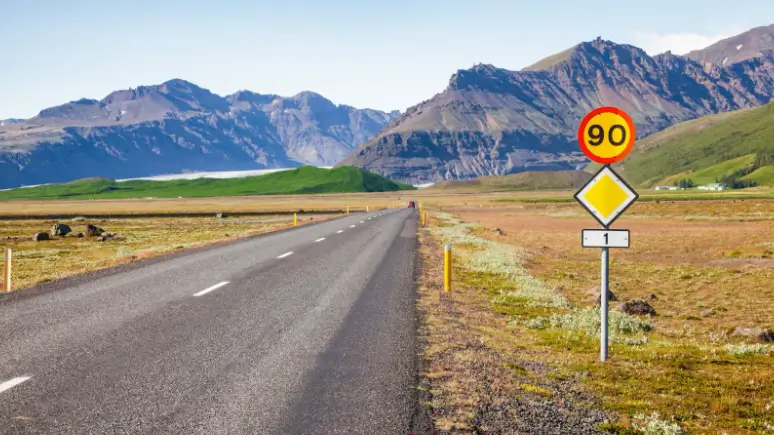
Road closures, weather, and official notices
Road conditions can change quickly. A sign, barrier, or official notice that says a road is closed means you should not continue, even if your navigation app still shows the route.
Before a long driving day, check current road conditions, weather warnings, closures, and vehicle suitability. Road signs and official road-condition notices override GPS directions. Use Road.is for live road information and SafeTravel for current travel safety guidance.
For more route-planning tools, see our travel apps for Iceland guide.
Icelandic road-sign words tourists should know
Most Icelandic road signs rely on symbols, so you will not need to translate everything at speed. A few words are useful to recognize before your trip.
| Icelandic term | Meaning | What to do |
| Malbik Endar | Paved road ends | Slow down before gravel begins. |
| Einbreið brú | Single-lane bridge | Check traffic and cross only when clear. |
| Lokað | Closed | Do not continue. Check the official route status. |
| Ófært | Impassable | Do not continue. |
| Vegur lokaður | Road closed | Turn back or choose another open route. |
| Inn/Út | Entrance/exit | Follow the access direction where relevant. |
Signs tourists commonly misread
Most of the misreadings below aren’t about missing a sign altogether. They’re about clocking it, filing it under something more familiar, and reacting a beat too late.
- F before a road number: This is easy to read as a normal route with a slightly odd label, especially if the road looks fine at the junction where you turn onto it. It identifies an F-road: a Highland route with its own opening dates and vehicle rules, which can change through the season even when the road itself looks unchanged from where you’re standing. Treat the F as the trigger to check current status and confirm your rental is actually permitted on it, before you commit to the turn, not once you’re a few kilometres in and the terrain has already changed under you.
- Malbik Endar: Drivers tend to register this as a general “drive carefully” sign rather than a specific one, so speed doesn’t change much when they see it. The gravel then arrives a few seconds later while you’re still going pavement speed, which is exactly the moment braking distance and steering response shift. It’s not a comfort warning; it’s a cue to slow down before your tires reach the loose surface, so the adjustment happens ahead of the transition instead of during it.
- Einbreið brú: The mistake here is timing rather than misunderstanding the sign itself. Visitors see it close to the bridge and only start slowing as they arrive, which doesn’t leave enough room to actually see oncoming traffic or work out if another vehicle has already started crossing. Lowering speed early enough to read the situation, rather than the bridge itself, is what turns this from a last-second judgment call into a straightforward yield.
- Lokað or a road marked closed: This is the one place a navigation app actively works against you. A route can look perfectly drivable on screen, sometimes still showing turn-by-turn directions along it, while the sign or barrier in front of you says otherwise. The sign and any official road-condition notice are the current information; the app is not tracking today’s closures, so it defers to whatever’s physically in front of the car.
FAQ
Are road signs in Iceland in English?
Many Iceland road signs use symbols rather than words, so they are understandable even if you do not speak Icelandic. When text appears, it is usually Icelandic. Learn a few terms such as “Malbik Endar,” “Einbreið brú,” “Lokað,” and “Ófært” before your trip, then use the sign symbol and the road conditions around you as the main guide.
What do yellow road signs mean in Iceland?
Yellow triangular signs with a red border are warning signs. They tell you about a hazard ahead, such as loose gravel, livestock, a blind rise, a narrow road, or strong wind. Slow down before you reach the hazard and adjust to the road conditions.
What does Malbik Endar mean?
Malbik Endar means “paved road ends.” It warns that the surface is about to change to gravel, where tires can lose grip more easily. Reduce speed before the transition, increase your following distance, and avoid sudden steering or braking.
What does Einbreið brú mean?
Einbreið brú means “single-lane bridge.” Slow down early, check oncoming traffic, and cross only when clear. The vehicle closer to the bridge generally has priority, but yield if the situation is unclear.
How do I know if a road is closed in Iceland?
Look for closure signs, barriers, and official road-condition notices, then check Road.is before changing your plan. Read our full guide to checking Iceland road conditions for the daily routine we recommend. Do not continue onto a closed or impassable road because a navigation app suggests it as a route.
What do F-road signs mean?
F-road signs identify mountain roads in the Highlands. These routes can have seasonal restrictions and may require a suitable 4×4 vehicle. Check the road status and your rental terms before driving them; a standard 2WD camper van is not the right vehicle for F-roads.
Is it hard for Americans to drive in Iceland?
Driving in Iceland is manageable with preparation, but rural roads can feel different from what many visitors are used to. Give yourself time for gravel, blind rises, one-lane bridges, wind, animals, and changing conditions. Our guide on how to stay safe in Iceland is a useful next read.
Plan your Iceland route with Rent.is
Understanding the road signs helps you make calmer decisions on the road. Before you choose a camper, think about your route, season, group size, and whether you plan to use F-roads. Not sure whether a 2WD or 4×4 camper is right for your route? We are only one email away and would love to help.