
Choosing between a 2WD campervan and a 4×4 campervan in Iceland can have a big impact on your trip. It affects more than just price. The vehicle you book will shape which roads you can legally drive, which campsites you can realistically reach, how flexible you are in changing weather conditions, and how comfortable your journey feels day to day.
That matters even more in Iceland, where your campervan is not only your transport but also your accommodation. A lot of guides explain 4×4 vs 2WD from a standard car rental perspective, but campervan travelers have different questions. Can you access the campsites on your itinerary in a 2WD campervan? Do you need a 4×4 for Highland roads? Where can you legally park overnight? And how much does the season really change the answer?
In this guide, we’ll break down the real differences between 4×4 and 2WD campervans in Iceland, including road access, campsite access, overnight parking rules, seasonal considerations, and which option makes the most sense for your itinerary and budget.
At a Glance: 4×4 or 2WD in Iceland?
- Choose a 2WD campervan if you’re visiting in summer and sticking to the Ring Road, Golden Circle, South Coast, and other main routes with easy campsite access.
- Choose a 4×4 campervan if you want to drive F-roads, visit the Highlands, reach more remote camping areas, or travel in winter or unpredictable shoulder-season conditions.
- A 4×4 is legally required on Iceland’s F-roads, and a 2WD campervan should not be driven there.
- For campervan travelers, the decision is not just about roads — it’s also about where you can camp, where you can park overnight, and how much flexibility you want if weather or road conditions change.
- If a plug-in-hybrid 4×4 is on your shortlist, see what to plan for a Jeep Wrangler 4xe camper van in Iceland before you choose a vehicle.
How to Choose Between a 4×4 and 2WD Campervan in Iceland
For most Iceland campervan trips, a 2WD is enough. If you’re traveling in summer and staying on main routes like the Ring Road, Golden Circle, and South Coast, it’s usually the most practical and affordable option. If you want to drive F-roads, explore the Highlands, travel in winter, or reach more remote areas, a 4×4 campervan is usually worth it.
The right choice depends on your route, season, campsites, and driving confidence — not just your budget. And for some travelers, the best option is a middle ground: a 2WD campervan for the main trip, plus guided access to more remote areas.
5 Questions to Help You Determine Whether You Need a 4×4 or 2WD
The easiest way to choose between a 2WD and 4×4 campervan in Iceland is to think about your trip first, not the vehicle. In most cases, the right option becomes obvious once you answer a few practical questions.
1. When are you traveling?
Season is the biggest decision point. If you’re visiting in summer, a 2WD campervan is often enough for the routes most travelers want to do. If you’re visiting in winter or during the more unpredictable shoulder seasons, a 4×4 campervan can make much more sense because conditions can change quickly, and route flexibility matters more.
2. Where do you want to go?
If your trip is focused on the Ring Road, Golden Circle, South Coast, Snæfellsnes, or other main tourist routes, a 2WD campervan is usually a realistic option. If you want to visit the Highlands, drive F-roads, or reach more remote areas with rougher access, you should be looking at a 4×4 campervan instead. If your route suddenly requires a 4×4 and you are driving a 2WD campervan, it becomes a question of legality and safety.
In this situation, the safest and simplest rule is: do not continue. In Iceland, F-roads are only for 4×4 vehicles, and taking a 2WD campervan onto them can leave you stuck, cause damage, and create insurance problems if you drive where your vehicle is not allowed. If this happens, the best option is to turn around, adjust your route, and choose an accessible campsite or destination instead.
3. Where do you plan to camp?
This is where campervan travel is different from a normal rental car trip. You are not just choosing how to drive — you are choosing where you can sleep. If your itinerary uses well-known campsites on standard routes, 2WD is often perfectly suitable. If your plans include more remote campsites or areas with rougher access roads, 4×4 may be the better fit.
4. How comfortable are you driving a larger vehicle in Icelandic conditions?
Campervans are bigger, heavier, and more exposed to wind than standard cars. Even on legal and accessible roads, gravel, strong side winds, and sudden weather changes can make driving feel more demanding. If you want the simplest and least stressful setup, your comfort level behind the wheel should be part of the decision.
5. What matters more to you: lower cost or broader access?
A 2WD campervan is usually the better value if your route does not require extra capability. A 4×4 campervan costs more, but that extra cost can be worth it if it gives you access to the places you actually want to visit or adds confidence in more difficult conditions.
Answering these questions clarifies your needs quickly. Main routes and summer plans? Opt for 2WD. F-roads, remote spots, or winter? Go 4×4. This keeps costs aligned with actual demands, avoiding overkill for simple itineraries.
Road Types and What They Mean for Campervans
Not all Icelandic roads place the same demands on a campervan. Paved roads and most of the country’s main travel routes are generally manageable in a 2WD campervan, especially in summer. Standard gravel roads can also be suitable for 2WD campervans in summer, although their size means extra care is still needed on loose surfaces. F-roads, however, legally require 4×4 vehicles and are also far more demanding in practice, especially with onboard living gear.
Vehicle choice is only one part of the decision, so check our driving in Iceland guide for the live road-status colors, wind warnings, and daily
Campsite Access and Overnight Parking in Iceland
Popular campsites along the Ring Road or Golden Circle pose no issue for 2WD vehicles. 4x4s unlock access to more remote areas with rougher approach roads, but remember: overnight stays must follow Iceland’s camping rules, which generally favor designated sites over wild camping, which is highly restricted.
Seasonal Considerations: Summer, Winter, and Shoulder Season
Summer favors 2WD on reliable roads with ample campsite options. Winter often makes a 4×4 the better choice amid snow and ice. Shoulder season travel (April-May, Sept-Oct) can vary significantly. Stick to main routes with 2WD, or choose 4×4 for extra adaptability.
Cost Comparison: Is a 4×4 Campervan Worth the Extra Money?
Expect 30-50% higher rates for 4x4s, along with higher fuel costs. They are worth the extra cost only if you actually need the added access, legality on F-roads, or more flexibility in difficult weather; otherwise, a 2WD campervan often delivers better value on mainstream routes.
Our Campervan Recommendations by Traveler Type
To make the choice easier, we’ve broken down the most common traveler types, whether a 2WD or 4×4 campervan is the better fit for each, and which models to consider.
Best for Budget-Conscious Travelers
If keeping costs down is a priority, a 2WD campervan is usually the best fit. It makes the most sense for travelers planning a summer trip on Iceland’s main routes, with overnight stops at standard campsites and no need for F-road access.
Suggested models: Renault Kangoo Camper, Fiat Doblo Camper, and VW Caddy Camper, all ideal for two travelers who want an affordable, practical campervan for summer trips on Iceland’s main roads and standard campsite routes. If F-road access matters more than luggage space, the Suzuki Jimny 4×4 with roof tent is also worth considering here — it’s one of the most affordable ways into genuine Highland territory, provided you’re traveling as a couple and packing light.
Best for Couples on a Classic Iceland Road Trip
For couples following a typical itinerary, such as the Ring Road, Golden Circle, South Coast, or Snæfellsnes, a 2WD campervan is often more than enough. It offers a simpler, lower-cost way to experience Iceland while still covering many of the country’s best-known highlights.
Suggested models: VW Caddy Camper, Fiat Doblo Maxi Campervan, and Renault Trafic 3. The Caddy and Doblo are strong fits for couples who want a simple, comfortable setup for Iceland’s main routes, while the Renault Trafic 3 is a good upgrade for couples who want a bit more interior space on a longer trip. All three are suited to classic itineraries rather than Highland travel.
If you’re weighing up comfort as well as route, our camper van size guide looks at the difference between a van’s sleeping capacity and how livable it actually feels day to day.
Best for Adventure-Focused Travelers
If your trip is built around going further off the beaten path, a 4×4 campervan is usually the better choice. It is better suited to travelers who want access to F-roads, Highland areas, more remote campsites, or rougher routes where extra capability really matters.
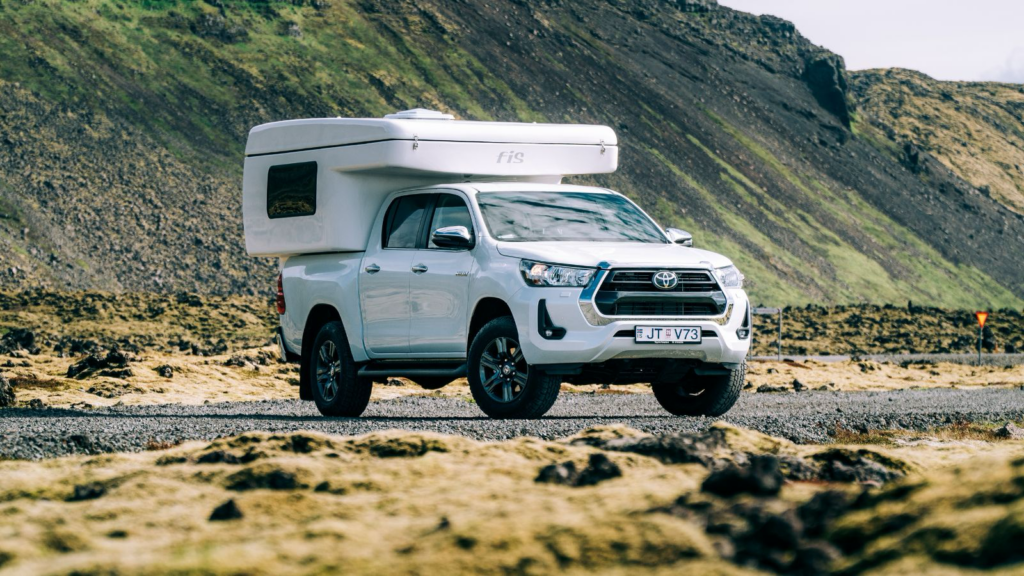
Suggested models: Jeep Renegade 4xe, VW California 4×4, VW California Beach 4WD, and Toyota Hilux 4×4 Camper. These models are the best fit for travelers who want to go beyond Iceland’s main routes and build a more adventurous itinerary. On the Rent.is fleet page, all four are marked Highland: Yes, making them better suited to trips that include F-roads, Highland areas, and more remote routes. If extra access and flexibility are central to your trip, these are the campervans most likely to make that upgrade worthwhile.
Best for Shoulder Season Travel
If you are visiting in April, May, September, or October, the right choice depends on your route, but a 4×4 campervan can offer more flexibility in less predictable conditions. For travelers sticking to easier roads, a 2WD may still work well, but those covering longer distances or more remote areas may benefit from the added confidence of a 4×4.
Suggested models: Dacia Duster 4×4 Roof Top Tent, VW California 4×4, and VW California Beach 4WD 2024 Model for travelers who want extra flexibility in changeable conditions, or Renault Trafic 3 and VW Caddy Camper for those sticking to easier main-road routes. Shoulder season travel in Iceland can vary a lot depending on your route and the conditions you encounter. The 4×4 options above are a better fit for travelers covering longer distances, heading into more remote areas, or wanting more confidence if the weather changes quickly, while the Renault Trafic 3 and VW Caddy Camper are better suited to travelers keeping things simpler on Iceland’s standard routes.
Best for Winter Travel
For most winter campervan trips, a 4×4 campervan is the stronger option. Winter conditions can change quickly in Iceland, and the extra traction and capability can make a meaningful difference, especially outside the easiest and most heavily traveled routes.
Suggested models: Toyota Hilux 4×4 Camper, Jeep Wrangler 4xe, and VW California Beach 4WD 2024 Model. For most winter campervan trips, it makes sense to focus on 4×4 options that offer more capability in tougher conditions without simply repeating the same shortlist as the shoulder season. These models are better suited to travelers who want more confidence in snow, ice, and fast-changing weather, especially if the trip goes beyond the easiest and most heavily traveled routes.
Best for First-Time Campervan Visitors
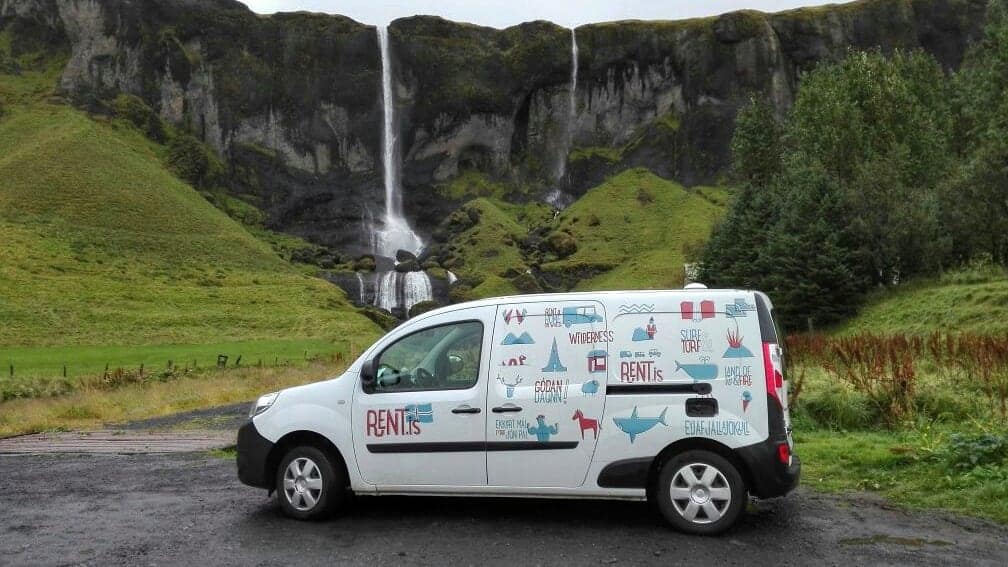
If it is your first campervan trip in Iceland, the best choice is usually the one that matches a straightforward itinerary. For many first-time visitors, that means a 2WD campervan in summer. It keeps the trip simpler, more affordable, and easier to plan while still allowing you to experience Iceland’s most popular regions.
Suggested models: VW Caddy Camper, Renault Kangoo Camper, and Renault Trafic 3. For first-time campervan visitors, the best choice is usually a model that feels simple, practical, and easy to plan around. These options are all better suited to straightforward trips on Iceland’s main routes, with the VW Caddy Camper and Renault Kangoo Camper working well for two-person road trips, and the Renault Trafic 3 offering a little more space for travelers who want extra comfort without stepping up to a larger vehicle.
Best for Travelers Who Want Maximum Flexibility
If you want the freedom to adapt your route, reach more remote areas, and build a more adventurous itinerary, a 4×4 campervan is likely the better fit. It gives you broader access and more options if your plans change along the way.
Suggested models: Toyota Hilux 4×4 Camper, VW California 4×4, and Crosscamp Flex 541. For travelers who want maximum flexibility, the best choice is a campervan that gives you broader access and more room to adapt as plans change. The Toyota Hilux 4×4 Camper and VW California 4×4 are strong fits for more adventurous itineraries and remote routes, while the Crosscamp Flex 541 offers an interesting middle ground for travelers who want more flexibility than a standard 2WD camper without moving into a full 4×4 setup.
Compromise: Taking Advantage of the Hybrid Approach
A hybrid approach can be a smart option if you want to keep costs down without missing out on Iceland’s more remote highlights, or if you’re just not comfortable driving on more challenging roads. Instead of booking a 4×4 campervan for your whole trip, you can choose a 2WD campervan for the main journey and join guided tours to reach places that are harder to access, such as the Highlands or other areas where road conditions are more demanding.
This is a practical way to get the affordability and simplicity of a 2WD campervan, while still experiencing destinations that would otherwise require a more capable vehicle.
4×4 vs 2WD Campers in Iceland FAQs
Can I drive the Ring Road with a 2WD campervan year-round?
Yes, a 2WD campervan can be used on the Ring Road, and it is a common choice for classic Iceland road trips. The important caveat is that year-round access does not mean year-round ease: winter conditions can change quickly, some stretches may become difficult, and road closures or warnings can affect your plans. For a summer Ring Road trip, a 2WD campervan is often enough. In winter, the better choice depends on the weather, your route, and how flexible you can be.
Which campsites require 4×4 campervans to access?
In general, campsites in the Highlands or campsites reached via F-roads require a 4×4 campervan. Landmannalaugar is one of the clearest examples, as access is via F208 or F225, both of which are mountain roads intended for 4×4 vehicles when open — our guide to driving a camper van to Landmannalaugar breaks down which of those two routes actually fits a rented camper van and what “4×4-approved” means on your booking. If your overnight plan depends on a campsite deep in the Highlands or at the end of an F-road approach, a 4×4 is usually the right choice.
Where can I legally park my 2WD campervan overnight?
A 2WD campervan should generally be parked overnight in official campsites or approved overnight camping areas. In Iceland, campervans do not have a general right to pull over and sleep wherever they like, even if the area looks quiet or remote. The simplest rule is to plan each overnight stop around designated camping infrastructure rather than treating the vehicle like a free pass to park anywhere.
What happens if I accidentally drive an F-road in my 2WD camper?
The safest response is to turn around as soon as it is safe to do so. F-roads are for 4×4 vehicles, and continuing in a 2WD campervan can increase the risk of getting stuck, damaging the vehicle, or creating insurance problems. If you make the mistake, it is far better to reroute early than to push on and turn a wrong turn into a much bigger problem.
Is a 4×4 campervan necessary in April/May?
Not always. April and May sit in Iceland’s shoulder season, so the right choice depends on your itinerary. If you are sticking to easier, lower-altitude main routes, a 2WD campervan can still work well. But if you want more flexibility, expect changeable weather, or plan to cover longer distances and more remote areas, a 4×4 can be the better option. Highland access is also still limited early in the season because those roads open only when conditions allow.
Can I reach Landmannalaugar campsite in a 2WD campervan?
No. Landmannalaugar is reached via F208 or F225, and access is limited to 4×4 vehicles during the summer opening period. Conditions and opening dates vary by year, but the typical access window is roughly late June to mid-September. Find out more in our guide to F-road opening times.
Do 4×4 campervans get better fuel economy than I think?
Sometimes, depending on the model. A 4×4 does not automatically mean terrible fuel economy, and smaller 4×4 options can be more efficient than many travelers expect. But in general, 4×4 campervans are chosen for access, legality on tougher routes, and flexibility, not because they are the cheapest vehicles to run.
Which Rent.is campervan is best for the Westfjords?
That depends on how adventurous your route is. For rougher roads and maximum flexibility, the Toyota Hilux 4×4 Camper is one of the strongest choices because it is built around more rugged travel. For travelers who still want a capable 4×4 campervan but with a more comfort-focused setup, the VW California 4×4 is also a strong fit.
Can I camp anywhere in Iceland with a 4×4 campervan?
No. A 4×4 campervan gives you more driving access, but it does not give you the right to camp anywhere you want. Overnight stays still need to follow Iceland’s camping rules, which generally mean using designated campsites or approved overnight areas rather than wild camping in a vehicle.
What’s the cheapest way to access Highland campsites?
If the Highlands are only a small part of your trip, the cheapest option is often a hybrid approach: use a 2WD campervan for the main route, then join a guided excursion or another organized option for the harder-to-reach areas. If Highland access is central to the trip, a smaller 4×4 camper can still be the better value than paying for a larger, more expensive model you do not need.
Do campervans handle Iceland’s wind better than cars?
Not necessarily. In many situations, campervans feel more exposed to the wind than smaller cars because they are taller and have a larger side profile. That is one reason why driving confidence, speed, and weather awareness matter so much when choosing the right vehicle for Iceland.
When do Highland campsites typically open?
Most Highland campsites open in summer, but there is no single fixed date for all of them. Openings depend on snow, thaw conditions, and when the roads become safe to use. Landmannalaugar is a good example: access is typically possible from around June 20 to September 15, depending on conditions that year.
For many travelers, a 2WD campervan is the right choice for Iceland, especially in summer, on main routes, and for trips built around standard campsites and classic highlights. But if your plans include F-roads, Highland access, winter travel, or more flexibility in changing conditions, a 4×4 campervan is often worth the extra cost.
The best choice comes down to the kind of trip you actually want to take. If you match your vehicle to your route, season, and camping plans, you will end up with a safer, smoother, and more enjoyable Iceland adventure. And if you are still unsure, choosing the campervan that fits your most demanding day, not just your easiest one, is usually the smartest way to decide.
We’re always happy to help, so if you’re having trouble choosing the right camper for your trip, get in touch!