
- Where is Reynisfjara Beach?
- Local Legends of Reynisfjara
- Wildlife at Reynisfjara Beach
- Reynisfjara in Film and TV
- Safety at Reynisfjara Beach: What You Need to Know
- What to See Near Reynisfjara
- Exploring Reynisfjara with a Rent.is Camper van
- FAQ
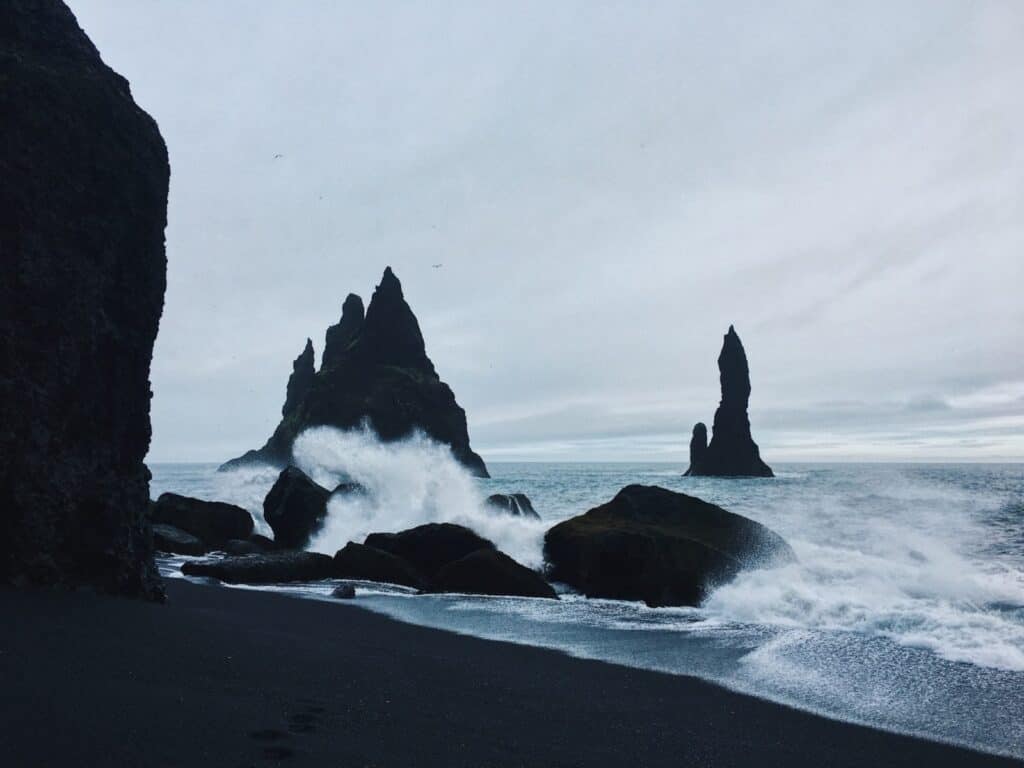
Reynisfjara is Iceland’s most visited black sand beach, and it earns that reputation. Located on the South Coast about 112 miles (180 km) southeast of Reykjavík, it’s where volcanic basalt columns rise straight from the sand, the Reynisdrangar sea stacks stand offshore like sentinels, and Atlantic waves hit with a force that demands your respect.
This guide covers everything you need to plan a visit: how to get there, what makes the beach worth the detour, how dangerous it actually is, the best time to go, and what else to see nearby on the same day. If you’re planning a South Coast road trip (as most people visiting Reynisfjara are), we’ll also show you why a camper van is the most practical way to do it.
Where is Reynisfjara Beach?
Reynisfjara sits about 112 miles (180 km) southeast of Reykjavík — roughly a 2.5-hour drive. Take Route 1 (the Ring Road) south toward Vík, then turn onto Route 215. The road leads directly to a signposted parking area with restrooms and a small café. There’s no public transport to the beach, so a car or camper van is your only real option.
The parking fee is ISK 1,000 (about $7) per car per day, payable at the lot. The village of Vík is about ten minutes east if you need fuel, food, or somewhere to stay the night.
Most visitors come as part of a South Coast day trip from Reykjavík, stopping at Seljalandsfoss and Skógafoss on the way. That’s a solid itinerary, but it does mean Reynisfjara gets busy between roughly 11 am and 3 pm. If you have flexibility over when you arrive, which a camper van gives you, early morning and late afternoon are noticeably quieter, and the light is better too.
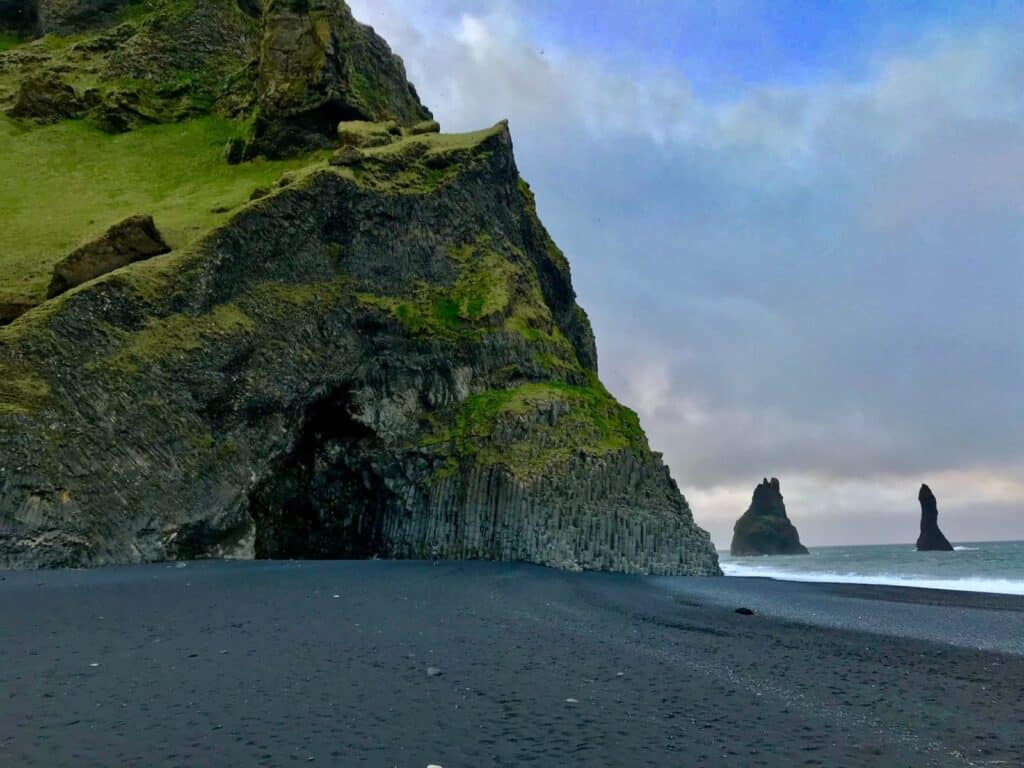
Most of Iceland’s black sand beaches are striking. Reynisfjara is something else. It’s the combination of elements in one place: the sand, the basalt columns, the sea cave, and the offshore sea stacks, that make it unlike anywhere else on the South Coast.
The black sand forms from basalt, the same volcanic rock that makes up most of Iceland’s coastline. After a volcanic eruption, when lava met the ocean here, it cooled rapidly and shattered into fragments. Centuries of wave action ground those fragments into the dark, coarse sand and pebbles that cover the beach today.
The basalt columns above the beach are a result of a slower process called columnar jointing. As lava cooled underground, it contracted and cracked into the long geometric shapes you see stacked along the cliff face. Near Hálsanefshellir cave, these columns form a cathedral-like interior that’s one of the most photographed spots on the South Coast. The cave is accessible on foot from the main beach — visit at low tide for the best access and to avoid getting cut off by the surf. Check tide times before you go.
Just offshore, the Reynisdrangar sea stacks rise dramatically from the water. In Icelandic folklore, they’re said to be trolls turned to stone by sunrise, caught in the act of dragging a ship to shore. At close to 66 meters (217 feet) tall, it’s easy to see why this legend emerged.
Local Legends of Reynisfjara
The Reynisdrangar sea stacks carry with them a rich tradition of folklore that intertwines myth with the natural world. Local legend tells of trolls who tried to pull a ship to shore but were caught by the rising sun and turned to stone, their forms now standing in the surf.
Another version tells of a grieving husband who sought revenge after trolls took his wife. He lured them out during daylight, turning them to stone and ensuring they would never harm another soul.
Reynisfjara also sits close to one of Iceland’s oldest churches, which local folklore says was built by an elf more than a thousand years ago, a reminder that Iceland’s mythological tradition runs deeper than any single landmark.
Wildlife at Reynisfjara Beach
Reynisfjara is one of the better spots on the South Coast for wildlife, but what you’ll see depends heavily on when you visit.
Puffins are the headline act. They nest on the cliffs above the beach from June through August, and they’re remarkably unbothered by visitors, meaning you can often get quite close without disturbing them. Outside that window, they’re gone entirely, heading out to sea for the winter, so if puffins are a priority, your travel dates matter. For more on where and when to see them across Iceland, see our guide to puffins in Iceland.
Year-round, the cliffs host fulmars and guillemots, and Arctic terns are common in summer. The terns are worth keeping an eye on; they’re small but territorial, and they will dive-bomb if they feel their nesting area is threatened.
Seals occasionally appear just beyond the surf, and on clear days, some visitors spot whales from the beach, though neither is guaranteed. Binoculars are worth packing if wildlife is a focus of your trip.
Reynisfjara in Film and TV
Even if you’ve never visited Iceland, you may have already seen Reynisfjara on screen. The black sand, volcanic cliffs, and Reynisdrangar sea stacks create a landscape that filmmakers return to regularly for fantasy, science fiction, and adventure productions.
The beach has appeared as Eastwatch-by-the-Sea in Game of Thrones, in Star Trek Into Darkness, and in Rogue One: A Star Wars Story. The basalt columns and Hálsanefshellir cave work particularly well as ready-made sets, and the contrast of dark sand against an open sky gives cinematographers a lot to work with.
If Iceland’s filming locations interest you, there are plenty more to explore along the South Coast and beyond. Our guide to Game of Thrones Iceland locations covers the wider trail.
Safety at Reynisfjara Beach: What You Need to Know
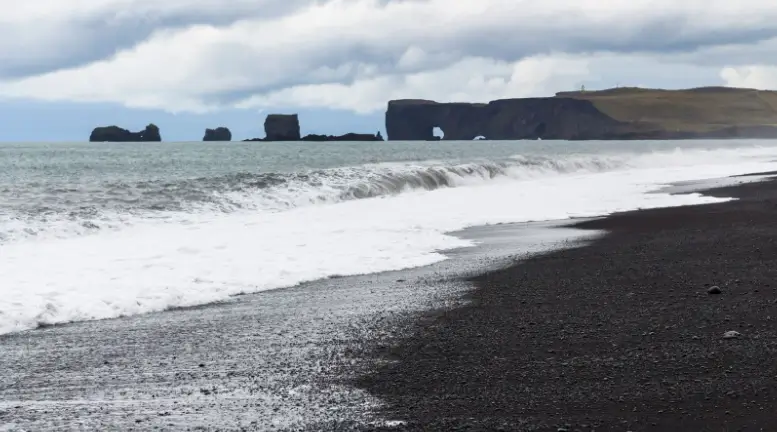
Reynisfjara is as beautiful as it is dangerous. Sneaker waves, large, unpredictable waves that surge far up the beach without warning, have killed visitors here. This isn’t a general coastal caution; it’s a specific, documented risk at this particular beach. The waves can reach areas that look completely dry and safe, and they move faster than you can run.
The rules are simple and non-negotiable:
- Stay at least 30 meters (98 feet) back from the waterline
- Never turn your back on the ocean
- Obey the warning signs and barriers — they mark where previous incidents have occurred
- If you see a large set of waves building offshore, move away from the water immediately
- Never let children near the waterline unsupervised
The ocean at Reynisfjara can look calm, and that’s when people get into trouble. It’s also worth noting that there is no lifeguard on the beach.
Before you visit, check current conditions at safetravel.is, which monitors hazardous locations across Iceland and issues alerts when conditions are particularly severe. For road and weather conditions on the way, road.is and the Icelandic Met Office are both worth checking.
If you’re visiting in winter, wave activity is generally more intense, and the beach is darker earlier. The risks don’t disappear in summer, but reduced daylight and rougher Atlantic swells in the colder months make caution even more important.
Best Time to Visit Reynisfjara
There’s no bad time to visit Reynisfjara, but the experience varies significantly depending on when you go — and a little planning makes a real difference.
Summer (June to August) is the most popular window for good reason. Puffins are on the cliffs, daylight is almost endless, and the weather is at its most forgiving. The Midnight Sun in late June/early July means you can visit at 10 pm in full daylight, which is also when the beach is at its quietest. The trade-off is that midday in summer (roughly 11 am to 3 pm) is peak crowd time. If you can avoid that window, do.
Shoulder season (April, May, and September) is increasingly the sweet spot for independent travelers. Crowds are noticeably thinner than in summer, prices are generally lower, and the landscape has a quality to it that peak season doesn’t — snow still caps the mountains in spring, and fall brings a low, golden light that works particularly well at a west-facing beach like Reynisfjara. Puffins are present through September before departing for winter, and in May, they’re just arriving. Daylight is comfortable for a full day of exploring without the intensity of the Midnight Sun. If your dates are flexible, this is the window worth targeting.
Winter (October to March) brings a completely different atmosphere. The beach is quieter, the light is dramatic when it appears, and there’s a real chance of seeing the Northern Lights on a clear night. Wave activity is more intense in winter, and daylight is limited, so plan your visit for midday when you have the most light, and be especially alert to the sneaker wave risk.
For photography, timing matters more at Reynisfjara than at most South Coast stops. The beach faces west, which means the light in the middle of the day is flat and harsh. Late afternoon and evening is when the low sun catches the Reynisdrangar sea stacks and the basalt columns properly. If you’re on a tour bus itinerary, you’ll almost certainly miss that window. A camper van lets you stay until the light is right.
What to wear: Reynisfjara is exposed on all sides. Wind is a constant, rain is frequent, and conditions can shift quickly regardless of season. Waterproof and windproof layers are essential year-round, as is sturdy footwear — the black sand and pebbles are uneven underfoot.
How long to spend: Give yourself at least an hour. The beach, the cave, and the sea stacks together reward a slower pace, and rushing means missing detail.
| Factors | Summer (Jun–Aug) | Shoulder (Apr, May, Sep) | Winter (Oct–Mar) |
| Daylight | 20+ hours | 10–16 hours | 4–6 hours |
| Crowds | High midday | Moderate | Low |
| Puffins | Yes | Partial (May arrival, Sep departure) | No |
| Northern lights | No | Possible (Sep, Apr) | Yes |
| Wave intensity | Moderate | Moderate | High |
| Photography light | Late evening | Late afternoon | Midday |
What to See Near Reynisfjara
Reynisfjara sits in one of the most rewarding stretches of Iceland’s South Coast, and most of what’s worth seeing nearby is within an hour’s drive. It’s easy to combine several stops in a single day without feeling rushed.
Vík is the closest town, about 10 minutes east along Route 1. It’s a small village, but a useful one — fuel, groceries, restaurants, and accommodation are all available here. The black sand beach at Vík itself is worth a quick stop, and the view back toward Reynisdrangar from the hill above the village church is one of the better vantage points on the coast.
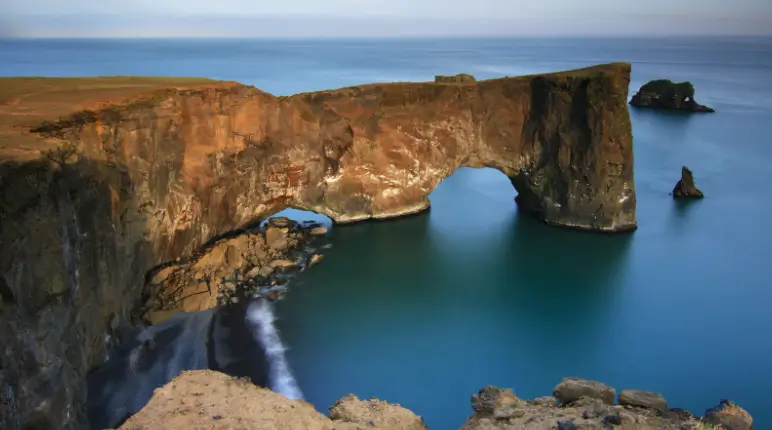
Dyrhólaey is about 15 minutes west of Reynisfjara and offers a completely different perspective on the same coastline. The lower viewpoint is accessible to all vehicles, but the upper viewpoint, which gives you an unobstructed view along the black sand coast in both directions, requires a 4×4. If that’s on your list, our 4×4 camper vans are well-suited to the access road. Dyrhólaey is also a puffin nesting site in summer, so it pairs well with the beach if wildlife is a priority.
Skógafoss is roughly 45 minutes west and is one of Iceland’s most impressive waterfalls — 25 meters (82 feet) wide and 60 meters (197 feet) straight onto the black sand riverbed below. You can walk behind the curtain of water and, in summer, climb the staircase alongside it for views up the valley. It fits naturally into a South Coast day if you’re driving the Ring Road. For more waterfall options along the route, see our guide to waterfalls in Iceland.
Sólheimasandur plane wreck is about 30 minutes west. A U.S. Navy DC-3 made an emergency landing on the black sand flats here in 1973, and the wreck has been left where it came to rest. It’s a 45-minute walk each way across open sand from the parking area, so factor in the time. No 4×4 required.
Seljalandsfoss is about an hour west and is usually combined with Skógafoss on a South Coast itinerary. The waterfall is walkable all the way around behind the curtain, which makes it one of the few in Iceland you can see from the inside. For a full picture of what the South Coast has to offer beyond Reynisfjara, our South Coast Iceland travel guide covers the complete route.
Exploring Reynisfjara with a Rent.is Camper van
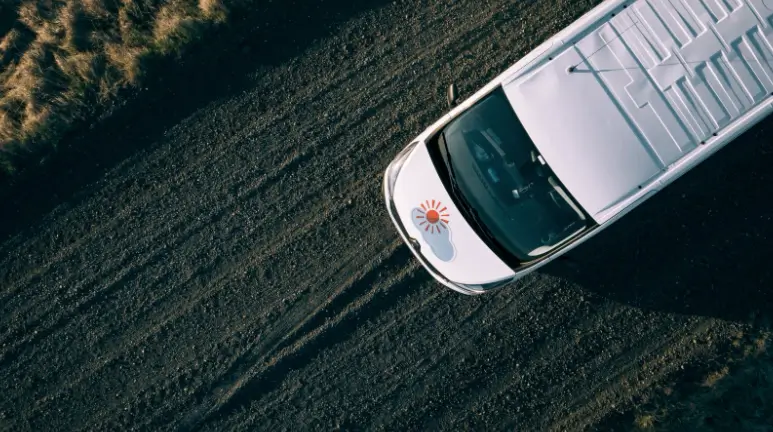
Most people visiting Reynisfjara are on a tour bus or a tight self-drive itinerary that puts them on the beach at the same time as everyone else — midday, when it’s busiest, and the light is flattest. A camper van changes that calculation entirely.
Reynisfjara faces west. The best light, the kind that makes the Reynisdrangar sea stacks and basalt columns worth photographing, arrives in late afternoon and stays through the evening. With a camper van, you can plan your arrival around that window rather than around a tour schedule. You can also leave Reykjavík early, beat the midday rush, spend the middle of the day at Dyrhólaey or Skógafoss, and return to Reynisfjara in the late afternoon when most visitors have already left.
The South Coast campgrounds near Vík put you within minutes of the beach overnight, which means you’re not locked into a same-day return to Reykjavík. Wake up early, walk to the beach before the parking lot fills, and have the sea stacks largely to yourself. That’s not possible on a day tour.
There’s a practical side to it, too. The South Coast is long, and the stops are spread out — Seljalandsfoss, Skógafoss, Reynisfjara, Dyrhólaey, and the plane wreck at Sólheimasandur. Covering all of them comfortably in a single day from Reykjavík is a stretch. With a camper van, you can take two days, stay near Vík overnight, and do each stop at the right pace.
If you’re planning a South Coast trip, browse our camper vans to find the right fit for your group. For the Dyrhólaey upper viewpoint and any F-road detours, take a look at our 4×4 camper vans specifically.
FAQ: Reynisfjara Beach
How do you get to Reynisfjara beach?
Reynisfjara is about 112 miles (180 km) southeast of Reykjavík, roughly a 2.5-hour drive. Take Route 1 (the Ring Road) south toward Vík, then turn onto Route 215. The road leads directly to a signposted parking area with restrooms and a small café. There is no public transport to the beach.
Is Reynisfjara beach dangerous?
Yes. Sneaker waves at Reynisfjara are unpredictable, powerful, and have killed visitors. They can surge far up the beach without warning, reaching areas that look completely dry. Stay at least 30 meters (98 feet) from the waterline, never turn your back on the ocean, and obey all warning signs.
What are the sea stacks at Reynisfjara called?
The sea stacks are called Reynisdrangar. In Icelandic folklore, they’re said to be trolls turned to stone by sunrise, caught dragging a ship to shore. The tallest stands at close to 66 meters (217 feet).
What is the best time to visit Reynisfjara?
Shoulder season (April, May, and September) offers the best balance of reasonable crowds, good daylight, and lower prices. Summer (June to August) is peak season with the longest days and puffins on the cliffs, but midday crowds are significant. Winter visits are quieter, but daylight is limited, and wave activity is more intense.
Are puffins at Reynisfjara year-round?
No. Puffins nest on the cliffs above the beach from June through August. They arrive in May and depart in September. Outside that window, they’re out at sea and won’t be visible from the beach.
Is there a parking fee at Reynisfjara?
Yes. Parking costs ISK 1,000 (~$7) per car per day, payable at the lot.
What is Hálsanefshellir cave?
Hálsanefshellir is a sea cave at the northern end of Reynisfjara beach, formed by the same basalt columns that line the cliffs above. It’s accessible on foot from the main beach and is one of the most photographed spots on the South Coast. Visit at low tide for the best access and to avoid getting cut off by the surf.
What can you do near Reynisfjara on a day trip?
Within an hour’s drive, you have Vík village (10 minutes east), Dyrhólaey viewpoint (15 minutes west), the Sólheimasandur plane wreck (30 minutes west), and Skógafoss waterfall (45 minutes west). Seljalandsfoss is about an hour west and is usually included on a full South Coast day.