
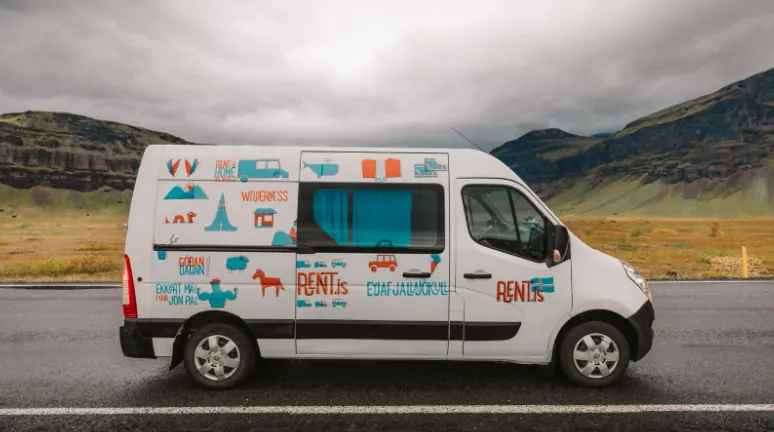
Sleeping Capacity Isn’t Comfort Capacity
A camper van listing that says “sleeps 4” is telling you how many bodies can physically lie down inside. It isn’t telling you whether four people can also cook dinner, get dressed, or ride out a storm without climbing over each other.
Take two vehicles from our own fleet. The Jeep Wrangler 4xe sleeps four in a rooftop tent, on a bed measuring 196 x 210cm — enough room to lie flat, but the tent is your only living space once you’re up there. The VW California 4×4, also built for four, splits sleeping across two proper beds inside the vehicle: an upper bed at 120 x 200cm and a lower bed at 145 x 180cm, both under the same roof as your kitchen and seating. Both vans are rated for similar sleeping counts. The day-to-day experience of living in them is where they differ.
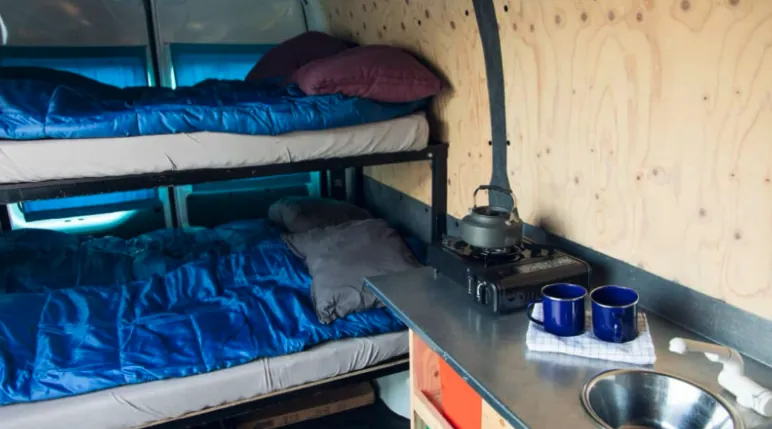
The number that actually matters when you’re choosing a camper size isn’t how many people the van sleeps — it’s how much of the interior is still usable once everyone’s sleeping bags are laid out. A compact van with a fixed double bed, like the Fiat Doblo Maxi, has little floor space left once the bed is made up — its own spec sheet notes there’s no standing room inside. A larger van or motorhome keeps a working kitchen and seating area even after the beds come out.
If you’re traveling for more than four or five nights, or you’re bringing more gear than a couple of daypacks, size up from what the sleep count alone suggests.
Where Does Your Luggage Actually Go?
Most size guides skip this part entirely, but Iceland’s roads have real camber, gravel sections, and the odd sharp turn, and anything sitting loose on a counter or upper surface will move while you’re driving.
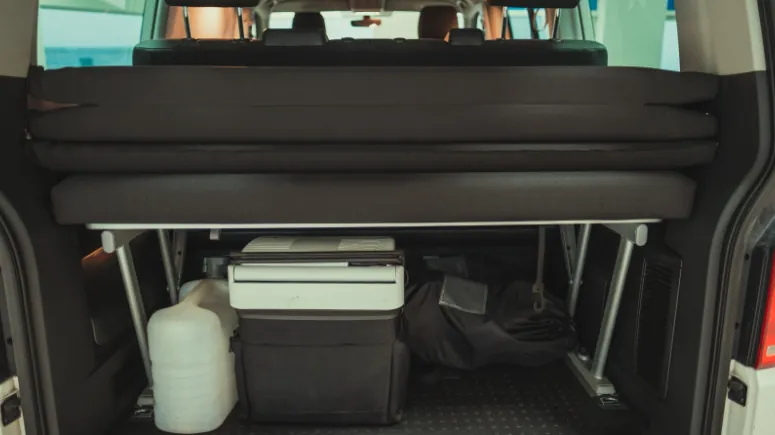
In a compact van, luggage typically goes under the bed platform or in the trunk — there’s rarely a dedicated space for it anywhere else. In general, traveling with soft luggage gives you more flexibility and space when it comes to storage. If you’re traveling with hard-shell luggage, that’s worth knowing before you book, not after you’ve packed the car. It could influence your decision in terms of which vehicle to book.
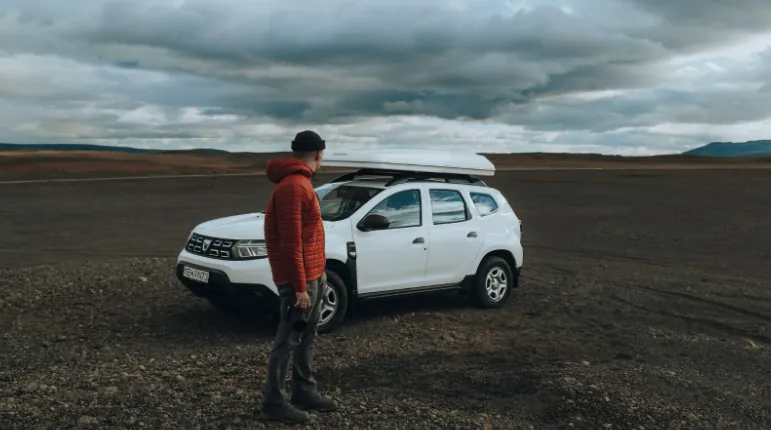
In vans with a rooftop tent, like the Dacia Duster, the sleeping area and the storage area are two different spaces entirely — gear stays in the main cabin overnight, which some travelers prefer and others find awkward when they need something from a bag before bed.
The practical rule: soft, squashable bags pack into odd-shaped storage far better than hard cases, regardless of which size you book. And if your group has more gear than a compact van’s under-bed space can hold, that’s a sizing decision, not a packing problem you can solve later.
The Rain-Day Test
Ask yourself one question before booking: what does a full day inside this van look like if it doesn’t stop raining?
In a compact two-person van, the honest answer is “not much.” There’s a bed, front seats, and not a lot else — cooking happens outside or through a side door, and there’s nowhere to sit upright that isn’t the driver’s seat. That’s a fine trade-off for a short Ring Road loop in July. It’s a harder one for a week-long trip in a wetter month.

A mid-size van like the Renault Trafic 3 changes this. It has an interior seating area with a table that converts to the bed at night — which means during the day, you have somewhere to sit, eat, and wait out weather without leaving the vehicle. The Renault Master 5 goes further, with roughly 2 meters of interior standing height, so most people can actually stand up inside rather than staying seated or hunched over.
The Motorhome 3 is the clearest example of what solves the rainy-day problem completely: it has a built-in toilet and small shower, along with a proper kitchen and dining area. If your trip includes several days of unpredictable weather — which, in Iceland, most trips do — that’s not a luxury feature. It’s the difference between a wet day being a minor inconvenience and one that ends your trip early.
Not sure which size fits your trip? View our full range of vehicles and compare sleeping setups side by side.
Camper Van Size Guide by Group
Solo Travelers
A compact van is genuinely fine for one person — you’re not competing with anyone else for space, and the smaller footprint means easier parking and lower fuel costs on longer routes. That said, if you’re traveling for two weeks or more, or you’re working remotely from the road, a mid-size van gives you enough room to actually spread out during the day rather than living entirely out of a single bed platform.
Couples
The “sizing up” advice comes up most often for couples, and for good reason. A compact van like the Fiat Doblo Maxi works well for a short trip with light luggage — it’s easy to drive, fuel-efficient, and well-suited to a classic Ring Road route. But for anything longer than about five nights, or if you’re bringing full luggage rather than daypacks, a mid-size van like the Renault Trafic 3 is worth the upgrade. The extra interior seating alone changes how a rainy afternoon feels. If you’re also weighing whether you need 4×4 capability for your route, our guide to 4×4 vs 2WD camper vans in Iceland covers that decision separately from size.
Three People
Three-person trips are where bed dimensions matter most, because the difference between vehicles isn’t just seat count — it’s how the sleeping area actually converts. The Renault Trafic 3 sleeps three on a 160 x 200cm bed that folds down from the daytime seating, which works well if everyone’s comfortable sharing one platform. If your group would rather have more separation between sleeping spaces, it’s worth checking a four-person van instead and simply not filling the fourth spot.
Family of Four
The sleeping-versus-comfort gap shows up most at this group size. A van rated for four can mean two proper double beds, like the VW California 4×4’s upper and lower setup, or it can mean a rooftop tent plus a fold-down bench — very different experiences for two parents and two kids. If your children still nap during the day, check the layout specifically: a rooftop tent has to be set up and folded down each time, so there’s no quick nap without stopping to camp, while an internal bed can be ready in minutes whenever you need it. If having a toilet on board matters — young kids mid-potty-training, for instance — the Motorhome 4 sleeps four with a built-in toilet and shower, one more than the Motorhome 3 covered above.
Group of Five or More
At this size, your options are a larger motorhome or two vehicles traveling together. The Renault Master 5 sleeps up to five with a functional kitchen and enough interior height to stand. For six or more, splitting into two vans is usually more practical than trying to fit everyone into one vehicle — Iceland’s stronger crosswinds affect large, boxy vehicles more than smaller ones, so a single oversized van isn’t automatically the easier choice for a big group.
| Group Size | Recommended Van | Sleeps | Best For | Consider Upgrading If… |
| Solo | Compact van | 2 | Short trips, easy parking, lower fuel costs | Trip is 2+ weeks or you’re working remotely |
| Couples | Fiat Doblo Maxi (compact) | 2 | Short trips (under 5 nights), light luggage, classic Ring Road | Trip is 5+ nights, or you’re bringing full luggage → Renault Trafic 3 |
| Three People | Renault Trafic 3 | 3 (160 x 200cm shared bed) | Groups comfortable sharing one sleeping platform | You want separate sleeping spaces → size up to a 4-person van |
| Family of Four | VW California 4×4 | 4 | Separate sleeping areas (two double beds) | You need a toilet/shower on board (young kids, potty training, etc.) → Motorhome 4 |
| Group of Five or More | Renault Master 5 | Up to 5 | Functional kitchen, standing height | Group is 6+ → consider two vans rather than one oversized vehicle |
CTA: Traveling as a family or a larger group? Check availability for our motorhomes and compare the layouts that fit your group size.
Van Spec Checklist Before You Book
Before you commit to a size, check these on the vehicle page rather than relying on the seat count alone:
- Check the bed dimensions and count — a “sleeps 4” listing can mean two 145cm-wide double beds or four narrower single positions, so look at the actual measurements rather than the headline number.
- Ask about the cooking position, since some vans cook from a slide-out tray through a side door while others, like the Renault Trafic 3 and Motorhome 3, have interior seating where you can cook and eat without stepping outside.
- Confirm the heating system — most of our fleet runs on Webasto heating, which works independently of campsite electricity. This is important if you know you’ll be arriving at a site after dark or staying somewhere without a hookup.
- Check where the power and USB ports are located, especially if you’re working from the road and need charging access from the sleeping area, not just the front cab.
- Consider standing height if anyone in your group is tall or you’re traveling with young kids who need to get dressed standing up — the Renault Master 5’s roughly 2-meter interior height is worth checking against more compact vans.
- Work out your realistic daily budget across rental, fuel, and campsite fees before you size up — our Iceland trip cost breakdown has real figures by vehicle type and trip length.
Why Rent.is Can Give You a Straight Answer
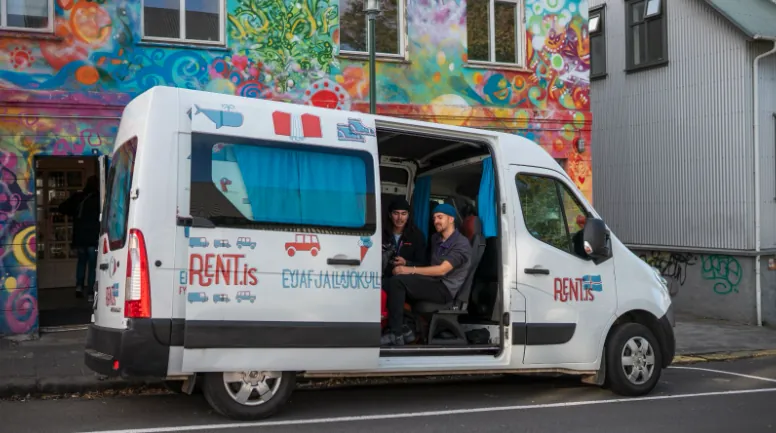
Most Iceland camper van companies stock one or two vehicle categories. We don’t. Our fleet runs from compact two-person vans through mid-size campers, 4×4 rooftop-tent vehicles, and full motorhomes with bathrooms, which means we don’t have an incentive to steer you toward whatever happens to be sitting in the lot.
If a compact van genuinely fits your trip, we’ll tell you that. If you’d be miserable in one — like the family of four with two young kids the Reddit community guide warned away from the smallest van — we’ll say that too. View the full range and check real-time availability to compare sizes side by side before you book.
FAQs
Can two people sleep comfortably in a two-person van?
Yes, but storage is limited. If you’re traveling for more than five days or bringing more than daypacks, a mid-size van gives you meaningfully more room for both sleeping and daytime living.
Is there space for luggage while we’re driving?
Each van has a dedicated storage area, usually under the bed platform or in the trunk. Avoid placing bags on counters or elevated surfaces while driving, since they can shift on hills and turns — pack into the designated storage instead.
What’s the difference between a camper van and a motorhome for a group of 4?
A camper van like the VW California 4×4 sleeps four across two beds but keeps cooking and living space compact. A motorhome adds a separate kitchen, dining area, and in some models a bathroom, which makes a real difference on longer trips or wet-weather days.
Do I need a bigger van if we’re traveling in winter?
Not necessarily for sleeping space, but heating matters more. Most of our fleet uses Webasto heating that runs independent of campsite power, which is worth checking regardless of the size you choose for a winter trip.
Can six people share one camper van in Iceland?
Realistically, no — six-person single-vehicle options are rare, and the logistics get complicated fast. Two smaller vans traveling together, or a larger motorhome for four to five plus a second vehicle, tends to work better than searching for one van to fit everyone.
Should I book a bigger van than my group needs, just in case?
It depends on your trip length and how much gear you’re bringing. For a short summer loop with light luggage, sizing up mainly costs you extra fuel and a larger vehicle to park. For a longer trip or anyone traveling with real luggage, the extra interior space usually pays for itself in comfort.
Does bed size affect which routes I can drive?
No — bed and sleeping capacity are separate from a vehicle’s road capability. Whether you can access F-roads or the Highlands depends on 4×4 capability, not how many people the van sleeps. Check both specs separately when you’re choosing a vehicle.