
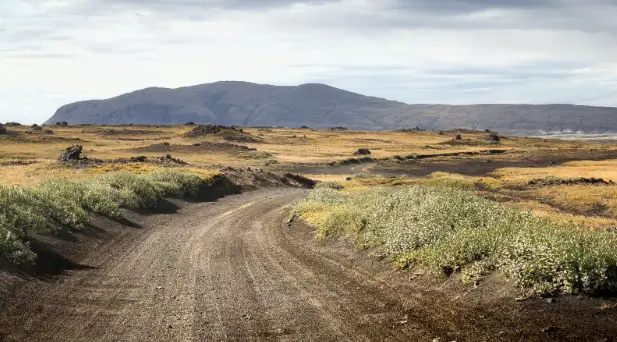
Iceland F-Road Opening Dates 2026: Full Road-by-Road Calendar
Last checked: July 8, 2026.
These dates are planning ranges based on typical historical Highland access patterns, not confirmed 2026 opening dates. Always check live status at umferdin.is before you drive. Vegagerðin updates current road and driving conditions through umferdin.is and its traffic information service.
When Do Iceland’s F-Roads Open in 2026?
In Iceland’s Highlands, most of the F-roads open between late May and mid-July, then close between mid-September and mid-October. Exact 2026 dates are not fixed in advance. Vegagerðin confirms each road only after inspection, so treat every opening date here as a guide, not a guarantee.
For camper van travelers, the useful question is not only “is the road open?” It is also “is this road open during my travel dates, and is my vehicle suitable for that route today?” A road that usually opens in June can still stay closed longer after a heavy snow year, and a river crossing that looked manageable yesterday can change after rain.
Iceland F-Road Opening Dates: The 2026 Calendar
The table below gives a planning view of the five F-roads travelers often ask about when building a summer Highlands route. Use it to check whether your trip dates are realistic, then confirm the live status close to departure.
Again, these are not guaranteed 2026 openings. They are typical seasonal ranges; road status can also change during the season, resulting in further closures. The final word always comes from Vegagerðin through umferdin.is.
| Road | Typical Open | Typical Close | Vehicle Requirement |
| F35 Kjölur | Early June | Late September to early October | 4×4 required. No unbridged major river crossing, making it the most approachable of these five roads. |
| F208 Fjallabak/Landmannalaugar approach | Early June from the north; Late June for the southern route | Mid to late September | 4×4 required. River crossings may be present depending on the entry point. |
| F26 Sprengisandur | Early July | Mid-September | Capable 4×4 required. This interior route usually has the shortest usable season of the five. |
| F261 Emstruleið | Early July | Mid to late September | 4×4 with high ground clearance. Bláfjallakvísl can become a medium-to-large crossing after rain. |
| F337 | Late June | Mid-September | 4×4 required. Shorter gravel/lava route in the Hlöðuvallavegur area. |
Important note: Vehicle damage caused by river crossings is not typically covered by rental insurance.
Compare our 4×4 fleet for Highlands routes
Reading the table correctly
“Typically open” means the road often becomes usable around that part of the season. It does not mean you can book a fixed date and assume the road will be open when you arrive.
Iceland’s F-roads open in stages. Lower or less complicated routes usually open before deep interior routes. F35 is normally one of the earlier and longer-season Highland routes because it does not have a major unbridged river crossing. F26 is different because it cuts deeper through the central interior and usually gives travelers a much tighter summer window.
That matters when you are planning a Ring Road plus Highlands trip. If your Highlands day is at the start of June, F35 may be a more realistic option than Sprengisandur. If your trip is in September, build in backup plans and check live status before committing to a long detour.
Why F-Road Opening Dates Change Every Year & What Determines Opening Dates
None of the F-roads open at exactly the same time. The decision happens road by road, after the route has been checked for snow, soft ground, water level, and whether the surface can handle traffic without being damaged. Why is it done this way? Iceland’s weather is unpredictable, and the Highlands are highly changeable. Checking every year to ensure each road is safe to open is the only way to keep vehicles moving and reduce the risks for travelers.
That is why you will not find a fixed 2026 calendar that says “F26 opens on June 28” or “F208 opens on June 17.” Those dates do not exist in a reliable way before the season. A typical range helps you plan the right month and vehicle category. It does not replace the live road check.
The interior routes are where timing matters most. F26 Sprengisandur usually opens later and closes earlier than Kjölur because it crosses deeper central Highland terrain. If you are combining the Ring Road with one Highlands crossing, this can change the order of your trip. You may need to keep the Highlands section in the middle of your travel window rather than using it as your first or last major drive.
Road-by-Road: What Each F-Road Actually Involves
Just as each F-road has a unique opening date, so too do they have their own terrain, driving demands, and route-planning trade-offs. Some are relatively approachable in the right 4×4, while others involve deeper interior driving, river crossings, or a much shorter usable season. Use the guidance below to understand what each road actually involves before you build it into your camper van itinerary.
F35 Kjölur
F35, usually called Kjölur, is the central interior route connecting South and North Iceland between the Langjökull and Hofsjökull glacier areas. It is still a Highland route, but among these five roads, it is the most approachable for travelers with limited F-road experience.
The main reason is simple: F35 does not have a major unbridged river crossing. That does not make it a normal paved road, and you still need to drive to the conditions, but it removes one of the biggest decision points travelers face elsewhere in the Highlands.
This is also why Kjölur often opens earlier and closes later than deeper interior routes. If your dates sit near the edge of the Highland season, F35 is usually the first route to check before building a more ambitious plan.
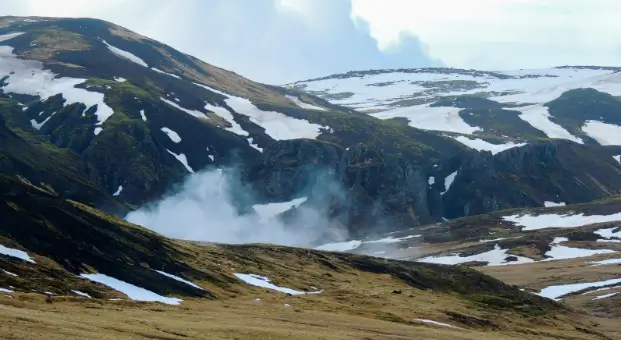
F208 is one of the key roads travelers look at when planning Landmannalaugar. The important detail is that “F208” does not behave like one simple access road. The northern approach and the southern Fjallabak route can have different openings and different driving demands.
The northern side typically opens earlier. The southern route usually comes later and can involve more demanding conditions, including river crossings, depending on the exact approach. That difference is easy to miss when you only see one road number on a map.
F26 Sprengisandur
F26 Sprengisandur is the classic north-south interior crossing through Iceland’s central Highlands. It is a very different planning decision from adding a short Highland detour to a summer Ring Road itinerary.
For timing, F26 is the route to treat most carefully on this list. It usually opens later than F35 and closes earlier, which gives it a shorter practical season. If you are planning a Ring Road plus Highlands combination, do not assume Sprengisandur will fit just because “the F-roads are open.”
That assumption causes real itinerary problems. A traveler arriving in late June may see that some Highland routes are opening and assume the central interior is ready too. It may not be. Check F26 separately, review the current status close to the drive, and have a route plan that does not depend on one road being open.
F261 Emstruleið
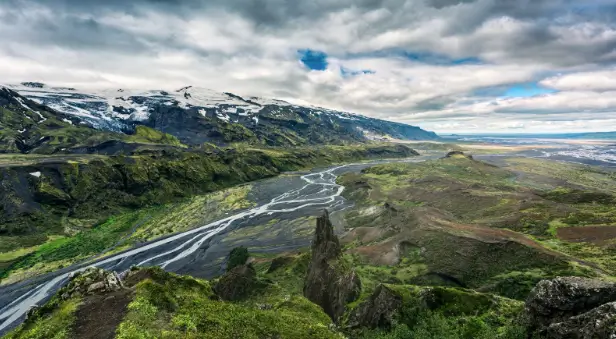
F261, Emstruleið, runs along the northern side of the Þórsmörk area and connects toward F210. It is easy to misunderstand this road if you are planning around Þórsmörk because F261 does not take you directly into the main Þórsmörk valley campsites.
The main practical issue on F261 is the Bláfjallakvísl river. After heavy rain, this crossing can become much more serious than it looked on a map or in a trip report from a dry week. That is why a 4×4 and a sense of adventure is not enough here: travelers should really stop to consider whether they are confident and experienced enough to tackle the route.
If your plan is hiking-focused rather than route-focused, read our Þórsmörk hiking guide for the area itself.
F337
F337 is a shorter interior route in the Hlöðuvallavegur area, with gravel and lava terrain rather than a long central crossing like F26. It gets less attention than F35, F208, and F26, but it still belongs in the same planning category: seasonal, condition-dependent, and not something to add casually to a 2WD itinerary.
Its typical season sits closer to the shorter Highland window, with late June opening and mid-September closure as the planning range. Because it is less commonly used as part of a full Ring Road route, it tends to suit travelers who have built dedicated Highlands time into their itinerary rather than those trying to add one quick detour.
As with the other roads in this guide, check the live status before departure and treat the table as a planning tool, not permission to drive.
Which Vehicle You Actually Need for Each F-Road
Choosing the right vehicle for an F-road is not just about picking anything labeled 4×4. Each route has its own mix of surface, elevation, river crossings, and seasonal conditions, so the right choice depends on where you are going and what the road is like when you get there.
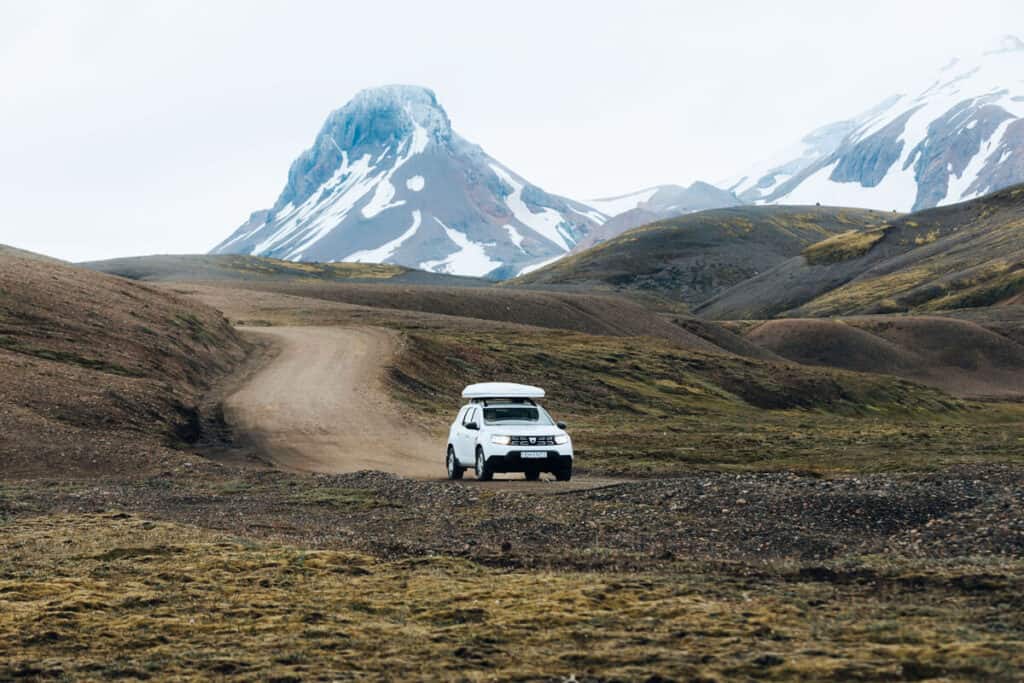
A 4×4 badge isn’t a route approval
Every road in this guide needs a 4×4 decision, but that does not mean every 4×4 is right for every road on the list. There are four separate questions to answer before you drive: what the vehicle can handle, what your rental agreement allows, what you have experience driving, and what the road or river conditions are today.
That distinction matters most on routes with river crossings. A vehicle may be 4WD and still not suitable for every F-road, and any damage caused during a river crossing is the driver’s responsibility. For more official guidance, check SafeTravel.
Do not treat “4×4” as a blanket approval for the Highlands. F35 and F261 are not the same kind of decision. F35 has no major unbridged river crossing. F261 has Bláfjallakvísl. The badge on the vehicle is only the start of the check.
Matching route to vehicle tier
- For F35 Kjölur, a suitable 4×4 camper is usually the simplest Highlands match in this guide. It still requires care, but the lack of a major unbridged river crossing makes it a more realistic first Highland route for travelers who want a central interior drive without taking on the same water-crossing decisions.
- For F208, choose a 4×4 with the route in mind, not just the destination. The northern approach toward Landmannalaugar is usually the more straightforward option, while the southern route can involve more demanding conditions and river crossings. If your plan depends on F208, check which approach you are taking before choosing your vehicle.
- For F26 Sprengisandur, think in terms of capability and commitment. This is a long central Highlands crossing with a shorter season, so it is not the route to add casually to a Ring Road trip. You need a capable 4×4, a confirmed open road, enough time, and a backup plan if conditions change.
- For F261 Emstruleið, ground clearance and river judgment matter. Bláfjallakvísl can become a serious crossing after rain, so this is not a road where the 4×4 label alone gives enough confidence. Check live conditions and do not attempt it if the crossing looks wrong for your vehicle or experience.
- For F337, a 4×4 is still the right category, even though the route is shorter. The decision is less about distance and more about Highland terrain: gravel, lava, seasonality, and whether the road is open and suitable on the day you plan to drive.
If you are deciding between camper categories, compare camper options before you book
You can also view our 4×4 campers and choose a vehicle around the roads you have confirmed are open.
How to Check Live F-Road Status Before You Drive
The live check matters more than any article, including this one. Use the typical opening calendar to plan the right travel month, then use the live road status before you drive.
The first place to check is umferdin.is, also referred to as road.is. It shows current road and driving conditions, including warnings and closures. You can also call the IRCA information phone line on 1777 (+354 522 1100) between 06:30 and 22:00.
Check the morning you leave, not when you book your camper van. Conditions can change during the day, especially after rain, thawing, or strong wind. If the map shows a road as closed or impassable, do not try it. Driving approved open F-roads is legal in the right vehicle; leaving the marked road is off-road driving, and off-road driving is illegal in Iceland.
Planning Your Trip Around F-Road Timing
Sequencing a summer trip
If your Iceland trip is built around the Ring Road with one or two Highlands sections, put the Highlands in the middle of the itinerary where possible. That gives you the best chance of matching your route to the open-road window.
In early summer, F35 is often the more realistic first check. Some deeper interior routes may still be closed or waiting on inspection. In July and August, the full Highlands window is usually at its strongest, though you still need to check the current status. In September, timing starts to tighten again. F26 may be closing while F35 remains open longer.
The safest planning habit is to treat the Highlands as flexible. Build your main camper van route so you can still have a strong trip if one F-road does not open in time, then use the live status to decide whether that section stays in the plan.
Find out more about planning with our guide to summer in Iceland.
Common Mistakes When Planning Around F-Road Dates
Three mistakes to avoid
The first mistake many travelers make is assuming all F-roads open together. As we’ve established here, they don’t – so you’re already a step ahead in your planning. The gap between the first and last opening can be several weeks, and that gap can decide whether your route works.
The second mistake is booking a 2WD camper van for a Ring Road trip, then adding a Highlands day later. If your route changes, your vehicle choice may need to change too. F-roads and 2WD vehicles do not mix.
The third mistake is treating a typical date as a confirmed 2026 date. A guide like this helps with early planning, but the final check has to happen closer to the drive. Check before you leave, and be ready to change plans if the road is closed or conditions look wrong for your vehicle and experience. The beauty here is that travelling with a camper van gives you more flexibility to react to the environment in Iceland around you.
F-Roads Opening Dates Overview
F-roads in Iceland usually open in stages from late May through early July, then close from mid-September through mid-October. F35 Kjölur normally opens earlier and closes later than the deeper interior routes. F26 Sprengisandur usually has the shortest practical season. Always confirm current status at umferdin.is before departure, and remember that vehicle requirements vary by road even when every route on your plan needs a 4×4.
F-road timing is useful for planning, but it is never a promise. Use the typical opening windows to choose the right travel month, build a realistic Highlands route, and decide whether your campervan needs to be a 4×4. Then check live road status before you drive.
Our team is always on hand to answer any questions or address any concerns you may have about traveling in Iceland’s Highlands. Don’t hesitate to get in touch with us!
FAQ
What are F-roads in Iceland?
F-roads are seasonal mountain roads that access Iceland’s Highlands. They are not off-road tracks. You must stay on the marked road, and you need the right vehicle for the route. For the full explanation, read our Highlands driving guide.
When do F-roads close in Iceland?
Most F-roads close between mid-September and mid-October, but the exact timing changes every year. Interior routes such as F26 Sprengisandur usually close earlier than more approachable routes like F35 Kjölur. Always check live status before driving.
Can I drive Iceland’s F-roads in a 2WD car?
No. Do not drive F-roads in a 2WD car or standard 2WD camper van. This is illegal. If your route includes the Highlands, choose a suitable 4×4 and check that the route is allowed under your rental terms.
Do all F-roads open at the same time?
No. F-roads open road by road after inspection. F35 often opens earlier than deeper interior routes, while F26 usually has a shorter season. That is why you need to check the specific road number, not just ask whether “the F-roads” are open.
Where can I check if an F-road is open right now?
Check umferdin.is for live road status and current warnings. You can also use the traffic information phone service 1777. Check on the morning you plan to drive, because conditions can change quickly.
Is insurance valid if I damage my vehicle on an F-road?
Coverage depends on your rental agreement, protection package, road choice, and the type of damage. Do not assume F-road damage is covered just because you have rented a 4×4. No insurance covers river-crossing damage. Find out more in our terms and conditions.