
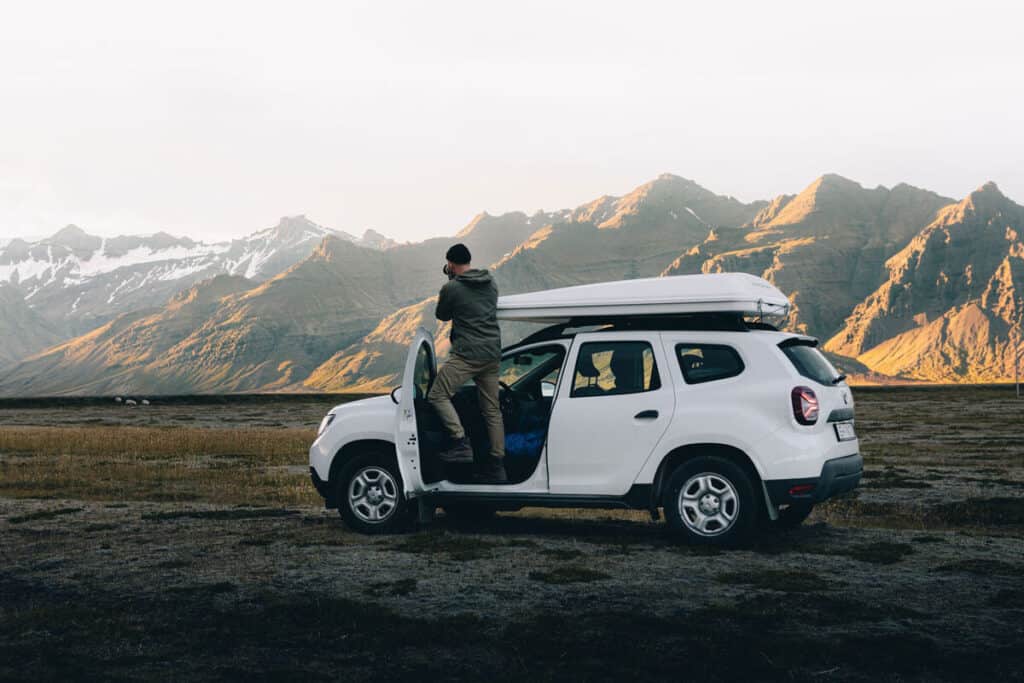
Every summer, as the snow retreats from Iceland’s interior, the same question lands in our inbox: can we take the camper into the Highlands? It’s easy to see why people ask. Away from the coast lies a different Iceland altogether, with color-streaked rhyolite mountains, black lava deserts, and hot springs at the end of long gravel tracks. The roads that lead there are the F-roads, the country’s summer-only mountain routes. And yes, you can drive some of them in a rental camper. The trick is getting three things to line up: the right vehicle, the right road, and the right day.
Of those three, the road is the place to start, because the approach you choose can change everything. Landmannalaugar, for example, can be reached by a route with no river crossings if you park before the river at the campsite and walk the last stretch over the footbridge, or by routes with several river crossings that we’d only recommend to experienced Highland drivers, not least because water damage isn’t covered by any insurance. And if neither suits your camper, a summer Highland bus will happily take you the rest of the way. Our Highland-capable 4×4 campers, from the two-person Suzuki Jimny with a rooftop tent to the four-berth Toyota Hilux and VW California 4×4, are a useful starting point, but the permitted route matters more than the label on the vehicle.
The quick answer, and three checks that matter
Yes, if you’re in a rental camper that’s explicitly permitted on that road, the road is officially open, and conditions are safe on the day. Standard 2WD campers aren’t allowed on F-roads, though one model can use a few non-F Highland routes, which we explain below, and even with a 4×4, your rental agreement may exclude particular roads or river crossings. Confirm the exact vehicle and route before booking, and check the road status again before leaving.
Use this three-check test before any Highland drive:
1. Road: Is the road open and legally accessible to your vehicle today? Check Iceland’s official road information at umferdin.is.
2. Rental: Does your rental agreement with us permit this vehicle on every planned road segment? If you’re unsure, get an answer from our team before you drive.
3. Conditions: Are the weather, road surface, river levels, and your experience suitable? SafeTravel and the Icelandic Met Office are useful last checks, ideally the evening before and again on the morning you set off, since cell coverage in the Highlands can be patchy once you’re on the road.
If the answer to any one of these is no or unknown, change the route or wait. Don’t treat a green road-status indicator as permission to take your particular rental vehicle there.
What exactly is an F-road in Iceland?
Iceland’s F-roads are mountain routes serving the Highlands. The “F” stands for fjall, the Icelandic word for mountain, and most of these roads only open in summer, once the snow has cleared, before closing again in September or October. Compared with the Ring Road and ordinary access roads, they can involve rough surfaces, steep sections, limited services and, on some routes, unbridged rivers. Fuel stations are few and far between, so fill up before you leave the paved road. The speed limit on gravel roads is 80 km/h (50 mph), but on most F-roads you’ll be going far slower, so allow more time than the distance suggests. The road number tells you which route you’re considering, but it doesn’t describe every hazard you’ll encounter.
Image alt text: Fuel stop distance sign on an Icelandic F-road
Look for the F-road designation on current official maps and signs. Some roads through the Highlands may have different number designations, and the same route can have easier and harder stretches. Several well-known Highland roads have also lost their F in recent years, including Kjölur (now Road 35), Kaldidalur (Road 550), and the northern approach to Landmannalaugar (Road 208), but you’ll still see the old F-numbers on Google Maps and in many travel blogs. Landmannalaugar itself shows why the detail matters: Road 208, which was once part of the F208, is no longer an F-road, but the final few kilometers into the valley, F224, are still an F-road. That’s why “We’re going to Landmannalaugar” isn’t enough information for us to check your route. Give our team the road number, intended approach, and how far you plan to drive.
Our Driving the Highlands in Iceland guide covers route planning, seasonal access, and wider Highland preparation. This article stays focused on whether a rental camper is permitted and suitable.
Which camper vans can use F-roads?
Most travelers comparing an F-road camper rental in Iceland start with the right question: what can I drive on my route? The answer depends on the exact model and terms, not only whether a vehicle is called a camper van, SUV, or 4×4.
Standard 2WD camper vans
For a classic Ring Road, Golden Circle, or South Coast trip, a 2WD camper is often all you need in suitable conditions. F-roads are a different story: Icelandic law only allows four-wheel-drive vehicles on them, and under our rental agreement, you’re also liable for any damage if you drive a non-4×4 vehicle on an F-marked road. So don’t take an ordinary 2WD camper onto an F-road on the assumption that the surface looks manageable.
The Crosscamp Flex is the one exception in our fleet. It’s a 2WD camper, but our current terms permit it on Kjölur (Road 35) and Kaldidalur (Road 550), both Highland routes that no longer carry the F designation, and on the northern approach to Landmannalaugar, Road 208 and the short F224 spur, as far as the parking area before the river. River crossings are not permitted in the Flex under any circumstances. In practice, that means Flex renters can still reach Landmannalaugar by parking before the river and walking the last stretch over the footbridge. This limited permission shouldn’t be read as approval for other routes, other 2WD campers, or travel beyond the stated point. Always check the current agreement before relying on the exception.
4×4 campers with an enclosed sleeping area
A 4×4 camper can give you a more suitable starting point for some Highland journeys, especially if you want the convenience of sleeping inside the vehicle. In our fleet, that means the VW California 4×4, the VW California Beach 4WD (2024 model), and the Toyota Hilux 4×4 Camper. All three are automatic, seat five, and sleep four, which makes them the natural choice for couples or small families who want a proper bed and a kitchen when the weather turns. The Hilux, a pickup with a heated camper house on the back, is the most rugged of the three and makes a comfortable Highland base, with built-in seating and a dining area, a small kitchen, and a sink, although running water is only available in summer.
One thing to watch: not every California we rent is a Highland vehicle, and the 2026 California Beach Hybrid isn’t approved for F-roads. Even with an approved model, you still need to establish whether it may use the intended road. Large size, ground clearance, tires, and vehicle weight can affect practical suitability. Don’t guess a wading depth or capability from photos.
4×4 vehicles with rooftop tents
A 4×4 SUV with a rooftop tent is another way to combine Highland travel with camping. The tent changes how you sleep, not which roads you can legally or contractually drive. Our Highland-approved rooftop-tent options run from the 2026 Suzuki Jimny, the smallest and nimblest for two people traveling light, through the fuel-efficient 2026 Dacia Duster and the Jeep Renegade 4xe, which both sleep two, up to the Jeep Wrangler 4xe, the most capable of the group, which sleeps four.
A couple of things tend to trip people up. Seats and beds don’t always match, so although the Duster and Renegade seat five, they only sleep two, and a group of four will need the Wrangler or one of the enclosed campers. And if you’re used to driving an automatic, it’s worth knowing that the Jimny and Duster are manual, while the Renegade and Wrangler are automatic. Rooftop tents also catch the wind, and Highland campsites are often exposed, so pack warm layers for the night. Choose based on your group size, luggage, road access, and comfort. Our 4×4 vs 2WD camper van guide explains the wider trade-offs.
Larger motorhomes
Motorhomes are a comfortable option on conventional road trips, but none of ours are Highland vehicles. The Crosscamp Lux 600, Motorhome 3, and Motorhome 4 are built for the Ring Road and paved routes, where their extra space, kitchens, and comfort really come into their own. If your preferred campsite needs a road your motorhome can’t use, stay on an accessible route and visit the destination by a suitable guided service instead, such as one of the summer Highland buses to Landmannalaugar.
Road rules, rental permission, and road conditions are different
It’s easy to mix up three separate decisions. Iceland’s road authorities decide which roads are open, we decide where our vehicles may go under the rental agreement, and the weather decides whether an open, permitted road is actually a good idea on the day.
Official road status
Check the actual road and any closure notices using umferdin.is, the live road-condition service run by the Icelandic Road and Coastal Administration. Highland opening periods vary with snow, thaw, and weather, so a date from a previous year’s trip report is a planning hint at best. To give you a sense of how much they move, the stretch of F208 from Sigalda to Landmannalaugar opened anywhere between May 23 and June 23 over the five years from 2021 to 2025. Our guide to F-road opening dates explains typical seasons, but the live road-status service takes priority on travel day. Driving a road that’s officially closed also makes you liable for any damage under our rental agreement, so a closure sign is never a suggestion.
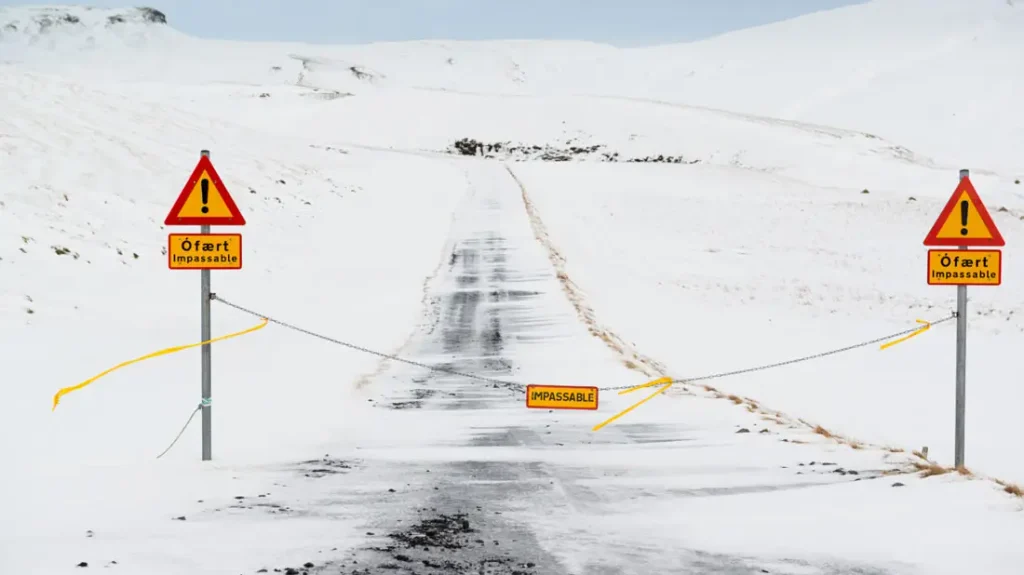
Rental agreement
Our terms may name a model, a route, or a stopping point, as the Crosscamp Flex example shows. If you haven’t had a clear answer from us, don’t drive the restricted section, and treat our terms and conditions as the reference for current exclusions, insurance, and penalties.
Conditions on the day
Mountain weather can change quickly, and rivers may rise after rain elsewhere in the catchment. Glacial rivers also tend to run higher in the afternoon, as warm weather speeds up the meltwater, so a crossing that looked manageable in the morning can be a different story on the way back. Check SafeTravel’s Highland driving guidance and the Icelandic Met Office before setting out. Even a permitted vehicle may need to turn back when visibility or river conditions are uncertain.
How to choose an F-road camper rental in Iceland
Start with your itinerary. Make a list of every planned Highland road, including any approach road to your campsite, then compare vehicles that fit the number of people traveling, the sleeping setup you prefer, and the access you’ve had confirmed. If this is your first time driving in the Highlands, Kjölur (Road 35) and Kaldidalur (Road 550) make a gentle introduction: both are rough gravel routes, but neither has river crossings.
The table below is a quick way to narrow down your options, but it isn’t an authorization list. No vehicle type can guarantee permission on a specific road, so treat it as a shortlist to check with us.
| Vehicle type | Our Highland options | Best for | Check before booking |
| 2WD camper | Crosscamp Flex only, on Roads 35, 550, and 208 to the river before Landmannalaugar. Our other 2WD campers aren’t permitted in the Highlands. | Ring Road trips, with a taste of Kjölur, Kaldidalur, or a walk-in visit to Landmannalaugar in the Flex | The stopping point on Road 208. No river crossings. |
| Enclosed 4×4 camper | VW California 4×4, VW California Beach 4WD (2024), and Toyota Hilux 4×4 Camper | Couples or small families who want an indoor bed and kitchen. All three sleep four and are automatic. The Hilux is the most rugged option. | Road numbers, river crossings, and season |
| 4×4 with rooftop tent | Suzuki Jimny, Dacia Duster, Jeep Renegade 4xe, and Jeep Wrangler 4xe | Adventurous couples. The Wrangler suits groups of four. | Beds vs seats, and transmission (Jimny and Duster are manual) |
| Large motorhome | None. The Crosscamp Lux 600, Motorhome 3, and Motorhome 4 aren’t Highland vehicles. | Comfortable Ring Road trips | Plan Highland visits by summer bus or guided tour |
A route-first booking method
Write down the road numbers and travel dates before you get a quote. If you plan to reach Landmannalaugar, for example, specify which approach you’ll take (Road 208 from the north, or F208 from the south or F225, which both involve river crossings) and where you intend to stop.
River crossings, insurance, and off-road driving
A river is the point where many otherwise sensible Highland plans need to change. Four-wheel drive doesn’t tell you how deep a vehicle can safely go, what the riverbed is like, or whether the water level will change during the day.
River crossings
Crossing a Highland river is one of the most dangerous things you can do on an Iceland road trip, and it takes real experience to judge safely. Rivers are often deeper and faster than they look; the riverbed can shift from one week to the next, and conditions can change within hours. We strongly advise against attempting a crossing unless you’re an experienced Highland driver in a vehicle that’s permitted to make it.
Just as important, water damage is never covered by any of our insurance packages, including Platinum Plus. If the engine floods or the electrics fail mid-river, the cost of the repair and the recovery is yours. A river crossing may also be prohibited for the vehicle itself. You shouldn’t attempt a crossing just because another car made it through or an older travel video shows it as easy.
If your route includes unbridged water and you don’t have clear permission and safe conditions, turn back or use appropriate guided transport.
Insurance and recovery
Our insurance doesn’t cover underbody damage either, and towing and recovery costs sit outside every package, including assistance when a vehicle is stuck in water, mud, sand, or snow. Towing and vehicle transport are charged at 450 ISK (~$3.60) per kilometer, which adds up fast in the Highlands, where the nearest help can be a long way off. If you do run into trouble, call our 24/7 breakdown line at +354 793-3030, also available on WhatsApp. Driving on a road your vehicle isn’t authorized for also carries a penalty fee: under current terms, it’s 100,000 ISK (~$805). Read the current terms before you pick up the keys. Don’t rely on the idea that “full cover” makes all Highland driving risks disappear.
Off-road driving is a different thing
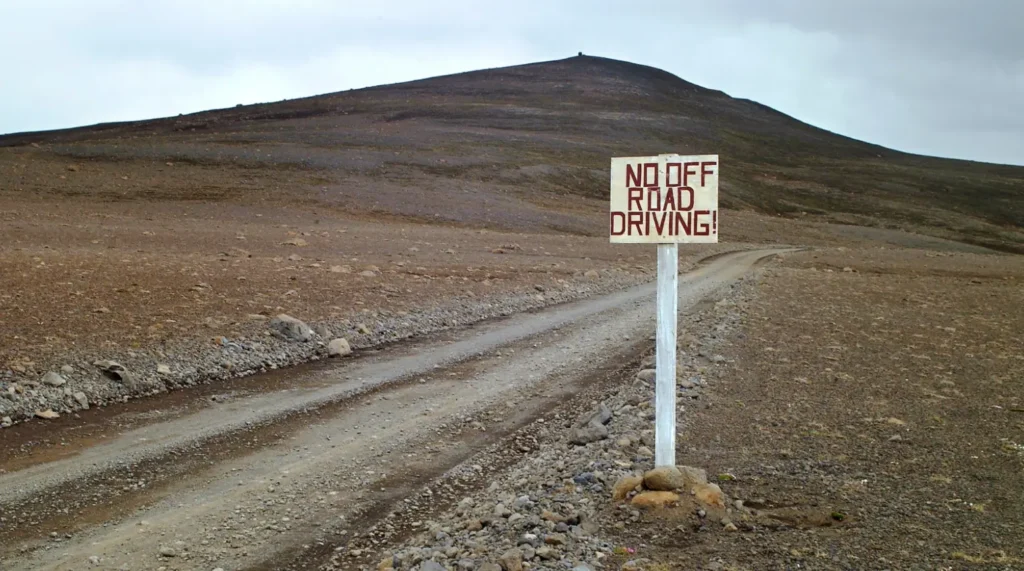
Driving on an authorized, marked road is different from leaving the road to cross open land. Driving off marked roads and trails is illegal in Iceland, and the fines are steep: in 2026, a group of French tourists was fined 400,000 ISK (~$3,220). Don’t drive around a barrier or make your own track to avoid mud or water. If the road isn’t passable, turn around.
Your four-point checklist before booking
When you contact us, include these four details:
1. Your planned dates and exact Highland road numbers.
2. The route sections you want to use, including the road to your campsite.
3. The specific camper model you’re considering and the number of travelers.
4. Any unbridged rivers, difficult segments, or known restrictions along the way.
A useful message to send is: “We’re planning to travel on Roads [numbers] on [dates] with [camper model] and [number] travelers. Is this vehicle permitted on every section of our itinerary? Are there any prohibited crossings or points where we must stop?”
Once we’ve replied, keep our written confirmation of your permitted roads, along with the relevant rental and insurance clauses, saved to your phone so you can check it offline once you’ve lost signal.
What if the road is closed or your camper isn’t permitted?
You still have options. Move the Highland stop to a day when the road is open, adjust your itinerary to a permitted road, or choose a Highland bus or Super Jeep service for the difficult section. Super Jeeps are heavily modified 4x4s on oversized tires, driven by guides who cross these rivers for a living.
Þórsmörk is a useful example. Its approach via F249 involves a series of river crossings that make driving into the valley a poor plan for any rental camper, and the last of them, the Krossá, has a reputation even among experienced local drivers. Our Þórsmörk camper van access guide looks at stopping earlier and continuing by bus or Super Jeep. Landmannalaugar works in a similar way, because summer Highland buses run there from Reykjavík, so even a 2WD Ring Road trip can include a day among its colorful rhyolite mountains.
Frequently asked questions about F-road camper rentals
Are all 4×4 campers allowed on F-roads?
No. A 4×4 drivetrain doesn’t override the rental agreement, road closures, or current conditions. Check the exact vehicle and every planned road segment with us before travel.
Can I drive an F-road with no river crossings?
Only if the road is open and the rental agreement allows your vehicle to use it. A route without a river can still be prohibited or unsuitable because of the road surface, terrain, or weather.
Does Rent.is ever allow a 2WD camper on Highland routes?
Only one, and only on specific roads. Our current terms approve the Crosscamp Flex on Kjölur (Road 35), Kaldidalur (Road 550), and Road 208 toward Landmannalaugar as far as the river before the campsite. These are Highland routes without the F designation, and river crossings aren’t permitted in the Flex under any circumstances. These are model-specific conditions, not a general 2WD permission.
Do I need to get rental-company approval in writing?
We strongly recommend it. Check the rental agreement and ask us to confirm your planned roads before booking. Getting the response in writing gives you a clear record of the specific vehicle, route, and exclusions discussed, and it’s worth saving to your phone so you can check it offline.
What if an F-road closes after I book?
Follow the official closure. Don’t drive it because your booking was made earlier. Change the route, wait, or arrange alternative transport, then check your reservation’s modification terms if the vehicle itself needs to change. It’s easiest to make changes more than 24 hours before pick-up, because modifications inside that window aren’t eligible for price adjustments.
Will insurance cover river damage?
No. Our terms explicitly exclude water damage caused by driving in rivers or watercourses and damage to the vehicle’s underside, whichever insurance package you choose, including Platinum Plus. Towing and recovery aren’t included either. Read the complete rental agreement to understand your liability and any other exclusions.
Is a rooftop-tent 4×4 treated differently from an enclosed camper van?
Not when it comes to road permission, because that depends on the exact model and the roads it’s approved for, not on how you sleep. In practice, though, a rooftop tent needs more care. Iceland’s wind can be fierce, Highland campsites are often exposed, and a tent on the roof catches every gust. Check the wind forecast on the Icelandic Met Office site before you set up, choose a sheltered spot where you can, and if strong winds are forecast, keep the tent closed and move somewhere more protected. Wind damage is the renter’s responsibility under our terms, and the roof tent isn’t covered by any insurance. Ask about the exact model and permitted roads, and then decide whether a tent or enclosed sleeping space works better for your trip.
Where should I check if an F-road is open?
Use Iceland’s official traffic and road-condition service at umferdin.is. Check SafeTravel and the weather forecast as well, then reassess on the day you intend to drive.
Can I drive a camper to Landmannalaugar?
Yes, in the right vehicle. The easiest approach is Road 208 from the north, which has no river crossings if you park before the river at the campsite. For routes, parking, and which campers can go, see our Landmannalaugar by camper van guide.
Choose your camper around the road you want to drive
A good F-road plan starts with a road number, a vehicle-specific permission check, and room to change your itinerary when conditions change. Get those right and the Highlands will reward you with some of the most extraordinary landscapes in Iceland. Compare our 4×4 campers, then get in touch with your route and dates. Our local team has been helping travelers plan Highland trips since 2012, and we’d love to help you choose a camper that suits the journey, whether that’s by email at rent@rent.is or by phone on +354 567 3000.